





Cartier’s Watches & Wonders 2026 novelties span sports watches and jewellery timepieces, avant-garde constructions and historic shaped watches, with a thread connecting them all: the Maison’s insistence on treating watchmaking and jewellery as one and the same discipline.
Santos-Dumont
The centrepiece of the Santos-Dumont refresh is a new LM-size reference in yellow gold featuring a dial in gilded obsidian. The volcanic stone, sourced from Mexico, owes its iridescent character to tiny air bubbles trapped within the material, making each watch unique. Cut to just 0.3 mm in depth, working with the stone presents considerable challenges for Cartier’s craftsmen. Once cut, it is polished to reveal its distinctive radiance.

Accompanying the obsidian dial is a newly developed flexible metal bracelet in yellow gold, drawing on the maison’s tradition of made-to-measure metal watch bracelets dating to the 1920s. The bracelet is composed of 15 rows and 394 individual links, each 1.15 mm thick, machined, finished, and assembled at the Cartier Manufacture before being attached to the case and clasp.

The Santos-Dumont range is also expanded with two further LM-size references in yellow gold and gold and steel, both with silvered satin-finish dials with a sunray effect, and a third in platinum with the same dial treatment. All new Santos-Dumont models are powered by the hand-wound manufacture 430 MC movement. Dimensions are 43.5 x 31.4 mm, thickness 7.3 mm, water-resistant to 3 bar.
Santos de Cartier Chronograph
The Santos de Cartier Chronograph revisits the model first launched in 2020, now in LM size at 47.5 x 39.8 mm with a thickness of 11.6 mm. Available in yellow gold, yellow gold and steel, and steel, it is designed around the dual brief of everyday wearability and performance. The dial features alternating satin and sunray finishes, with black sword-shaped hands coated in Super-LumiNova® for legibility in low light. Three counters are arranged across the dial: Seconds at 6 o’clock, minutes at 3 o’clock, and hours at 9 o’clock, each encircled by a ring finished in yellow gold or rhodium, depending on the reference. The dial required more than 70 production steps. The case is framed by eight polished screws, and the heptagonal crown is set with a synthetic blue faceted spinel or a sapphire on the gold model.

Its power comes from the 1904-CH MC automatic chronograph calibre, offering a 47-hour power reserve and water resistance to 10 bar. Each version includes a second strap: The yellow gold model with semi-matt dark grey alligator, and the two steel-including versions with black rubber. The bracelet features Cartier’s SmartLink™ adjustment system and QuickSwitch™ for rapid interchange between bracelet and strap. The Santos Chronograph is scheduled for release in June 2026.
Baignoire
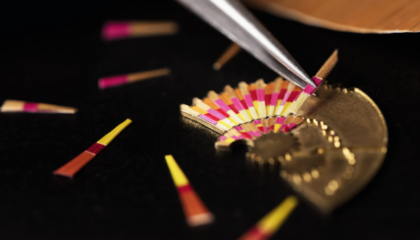
First appearing in 1958 and officially taking its name in 1973, the Baignoire is one of Cartier’s most distinctive jewellery timepieces. In 2023, the Maison introduced a bangle bracelet edition, and at Watches & Wonders 2026, it takes that design further by adorning the entire watch, from bangle to case to dial, with the Clou de Paris motif. This pyramidal hobnail pattern has been part of Cartier’s stylistic vocabulary since the early 1920s and requires specific craftsmanship to mould gold while preserving the evenness of its shape and volume.
The motif is rendered in monochrome yellow gold to maintain visual continuity across the whole piece, with proportions carefully adjusted to follow the Baignoire’s oval curves as closely as possible. Even the yellow gold push-buttons on the clasp are designed to blend seamlessly into the bracelet line. The final polishing stage — carried out entirely by hand — demands precision to preserve and accentuate the relief of the motif.
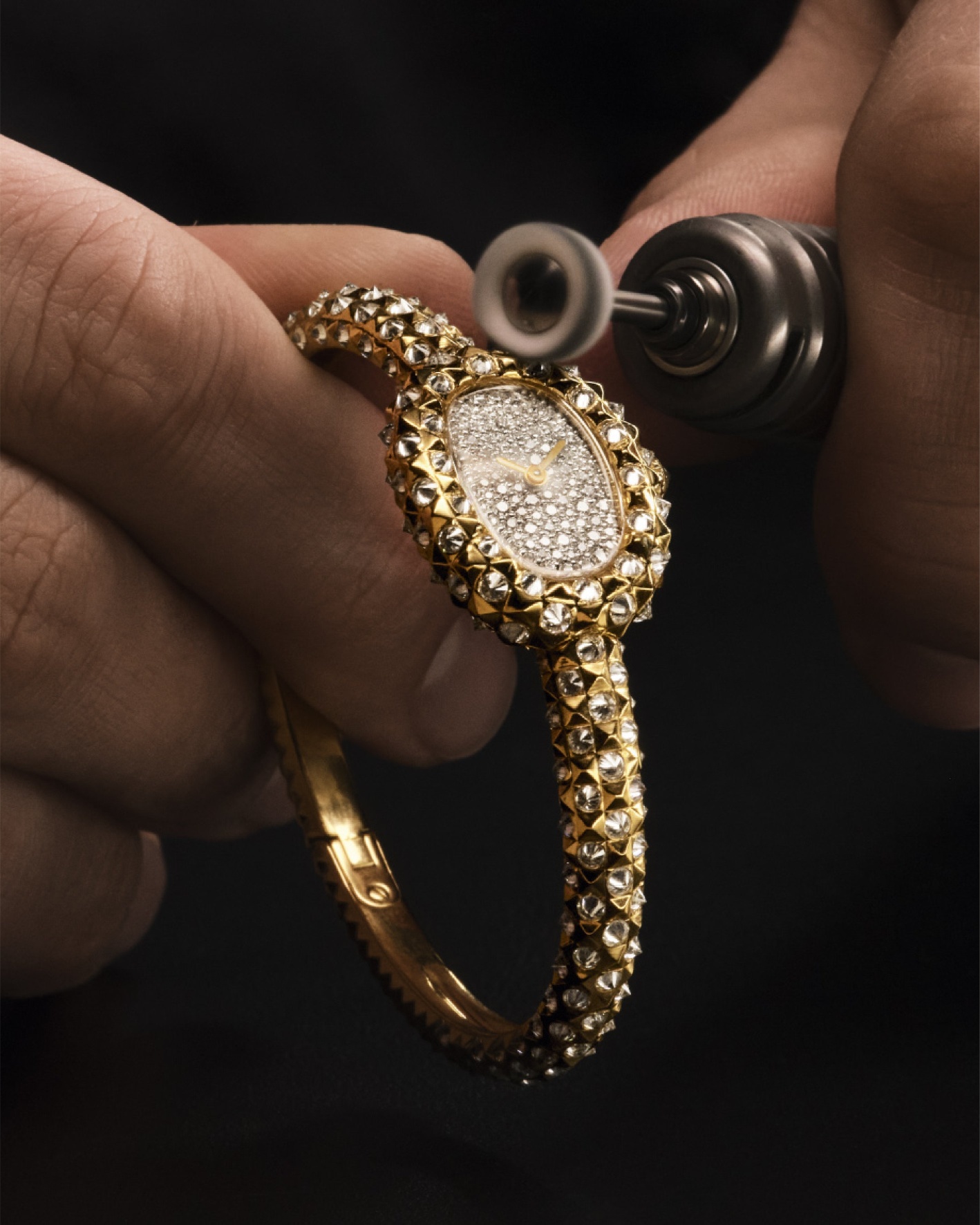
The collection launches in two bangle versions: A yellow gold model with a golden dial, available in sizes 15, 16, and 17, and an ultra-precious version with the case and bangle set with 171 brilliant-cut diamonds (4.70 ct) and a dial set with 100 brilliant-cut diamonds (0.46 ct) in a snow setting, available in sizes 15 and 16. On the diamond edition, an inverted setting has been used on the case for stones with a slightly less pronounced tip, creating a layered interplay between the diamonds and the Clou de Paris relief. Both bangle references measure 24.6 x 19.3 mm, thickness 7.5 mm, quartz movement, water-resistant to 3 bar.
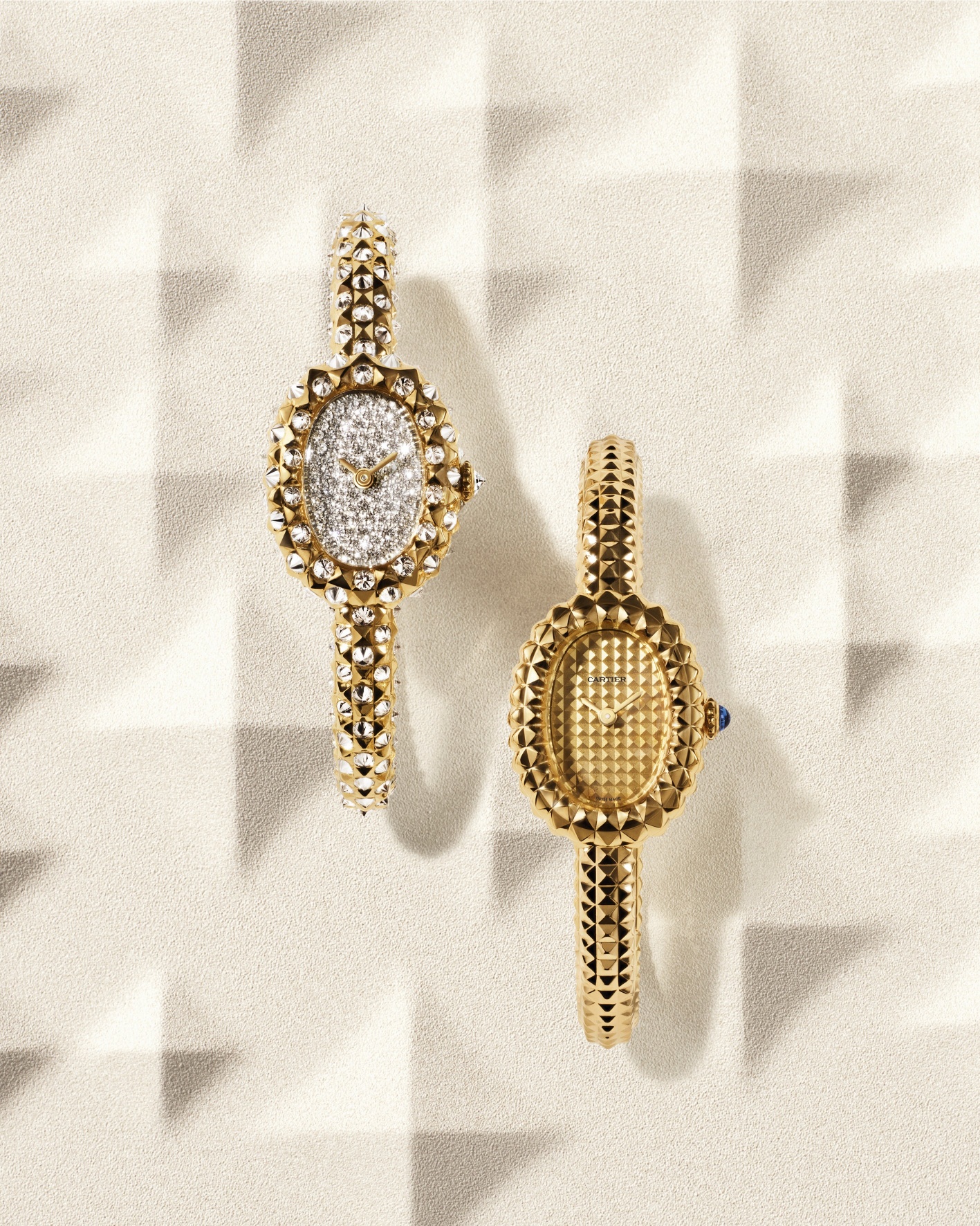
Three additional strap references complete the Baignoire lineup: A yellow gold model with a diamond-set dial (100 brilliant-cut diamonds, 0.46 ct) on a black patent calfskin strap (24.6 x 18.7 mm, 7.2 mm thick); a larger yellow gold model with a grained silvered dial on a shiny black alligator strap (36 x 26 mm, 8.6 mm thick) fitted with a high-autonomy quartz movement; and a yellow gold model with a black lacquered dial on a shiny black alligator strap (31.4 x 23.1 mm, 7.3 mm thick). All are quartz-powered and water-resistant to 3 bar.
Tortue
The Tortue, one of Cartier’s oldest shaped watches, dating to 1912, receives its most thorough reinterpretation in years. Completely redesigned by the Cartier design studio, the new collection features rounder, more generous proportions and softened lines intended to feel smooth and tactile against the wrist. The iconic Roman numerals are retained, but the classic guilloché dial pattern gives way to an embossed motif that adds tactile relief. The rail track has been transformed into a line of dots — a nod to a 1922 Cartier watch that featured a dotted line on the bezel — and Cartier’s secret signature has been integrated into a stroke of the Roman numeral X.
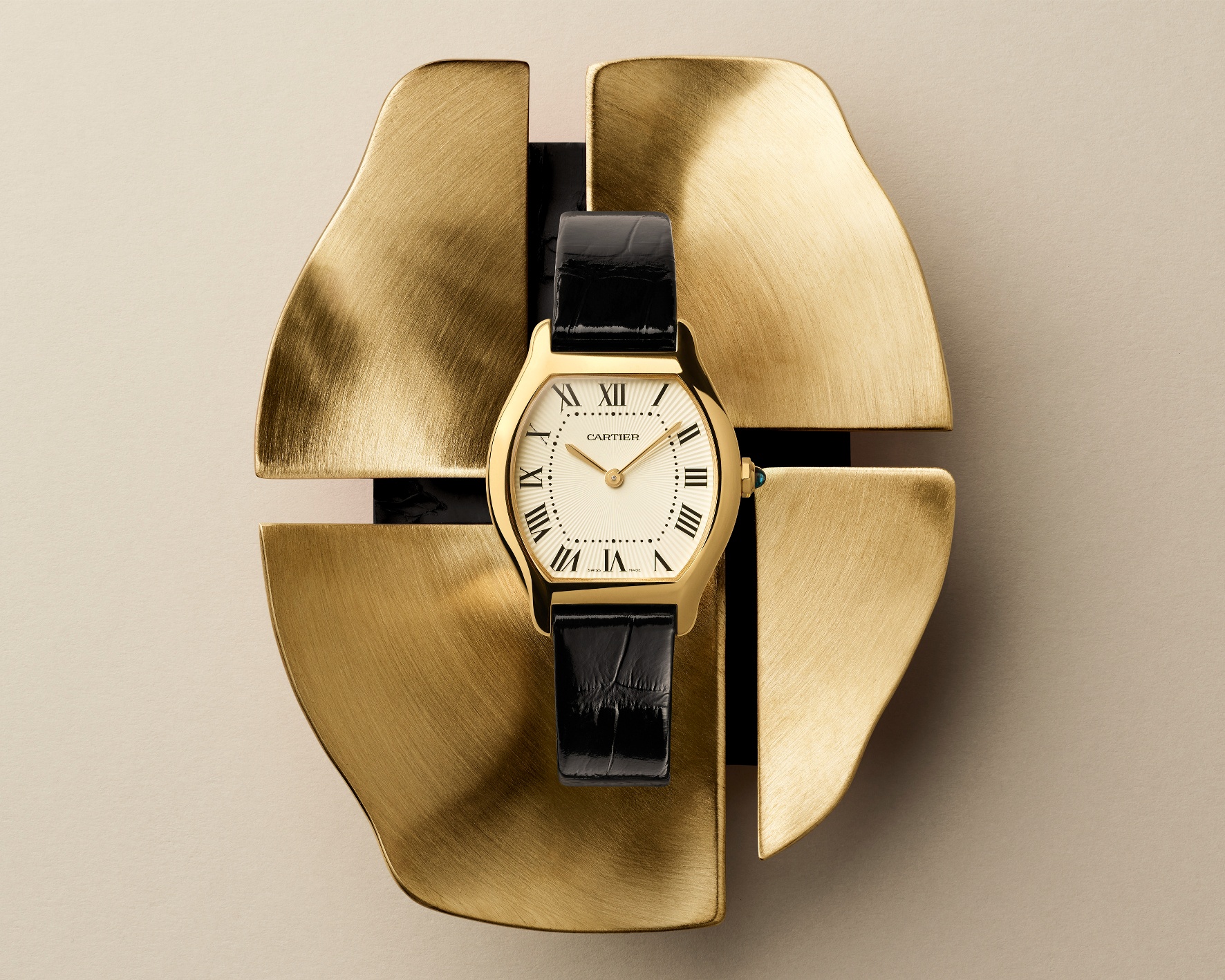
Five new references make up the core collection in small and mini sizes across yellow gold, rose gold, white gold, and diamond-set versions. The yellow gold small model features a champagne-coloured dial on a shiny black alligator strap (33.4 x 26.7 mm, 7.2 mm thick). White gold versions in small and mini sizes feature diamond-set cases and bright navy blue alligator straps — the small model carries 48 brilliant-cut diamonds (1.32 ct), the mini 42 (0.77 ct). Rose gold models in both sizes come on red alligator straps, the small version set with 48 brilliant-cut diamonds (1.32 ct), the mini with 42 (0.77 ct). The pavé diamond bezels on the precious versions use a cut-down setting to maximise brilliance, and the octagonal crown is set with an inverted diamond. The white gold version pairs with a blue patent alligator strap; the rose gold with a burgundy strap. All five references are powered by a high-autonomy quartz movement, water-resistant to 3 bar.
At the top of the Tortue lineup sits a platinum LM reference with a bezel set with 46 baguette-cut diamonds (2.7 ct) — a cut the Maison has employed since 1910. The octagonal crown carries an inverted brilliant-cut diamond, and the white gold double folding clasp is set with 32 additional baguette-cut diamonds (0.63 ct), bringing the total diamond weight to 3.41 carats. The guilloché dial is read through rhodium-plated apple-shaped hands, and the watch is powered by the hand-wound manufacture 430 MC movement. Dimensions are 41 x 33 mm, thickness 7.2 mm, water-resistant to 3 bar. A grey alligator strap and a second blue strap are both included.
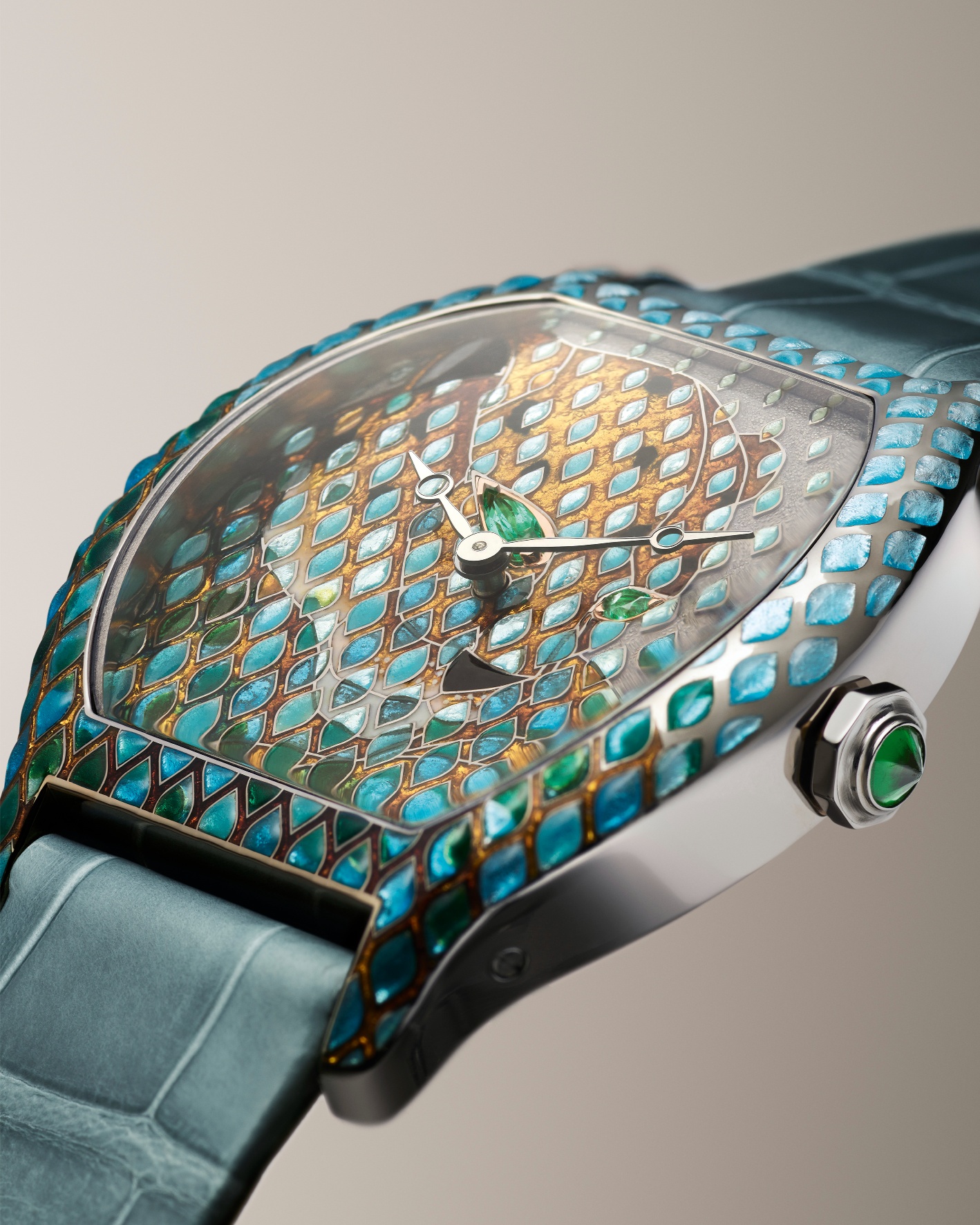
The most technically complex piece in the Tortue presentation is the Panthère Métiers d’Art Tortue Watch, produced in two limited editions of 100 numbered pieces each. Developed by craftsmen at Cartier’s Maison des Métiers d’Art, the watch depicts the iconic Cartier panther at rest behind a curtain of rain, rendered through champlevé enamel extending across both the dial and the case middle. The motif is constructed on two levels of depth using tiny carved cavities filled with translucent enamel powder mixed with gold or silver flakes.
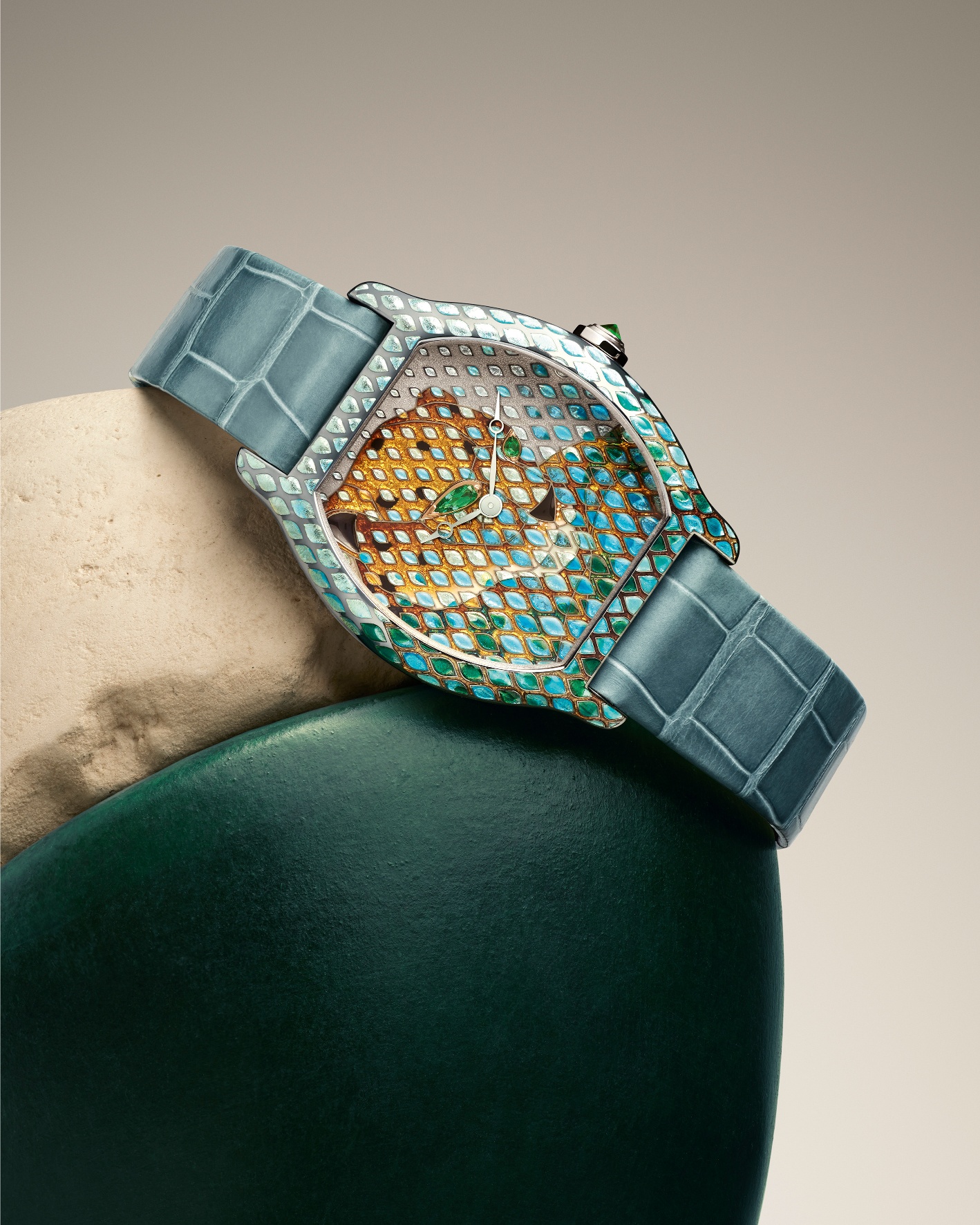
Over 15 tones were used in each piece, requiring more than 36 individual firings; the dial alone required 80 hours of enamelling, the case a further 50 hours, and setting the eyes took 3 hours. The white gold version features emerald eyes, an onyx nose, and an inverted-set emerald crown on a semi-matte bluish grey alligator strap; the yellow gold version has tsavorite eyes, an onyx nose, and a tsavorite crown on a brilliant deep green alligator strap. Both are powered by the hand-wound manufacture 430 MC movement and measure 43.7 x 34.8 mm, with a thickness of 8.9 mm, water-resistant to 3 bar.
Myst de Cartier
A new addition to Cartier’s creative watchmaking universe, the Myst de Cartier is conceived as much as a sculpture as a watch. Its lineage traces back to the jewellery watches created under the direction of Jeanne Toussaint in the early 1930s — pieces that were, as Pierre Rainero, Director of Image, Style and Heritage, describes them, both sculptural and flamboyant.
The watch’s defining characteristic is its construction: It has no clasp, evoking the effect of a trompe-l’œil bracelet. Its elements are strung together like beads, each one designed to resemble a protective talisman. The composition places alternating curved volumes in contrast with a domed crystal and a geometric pavé dial, surrounded by a delicate onyx frame with a triangular hour-marker. Black lacquer details unify the design in a bold symmetry.
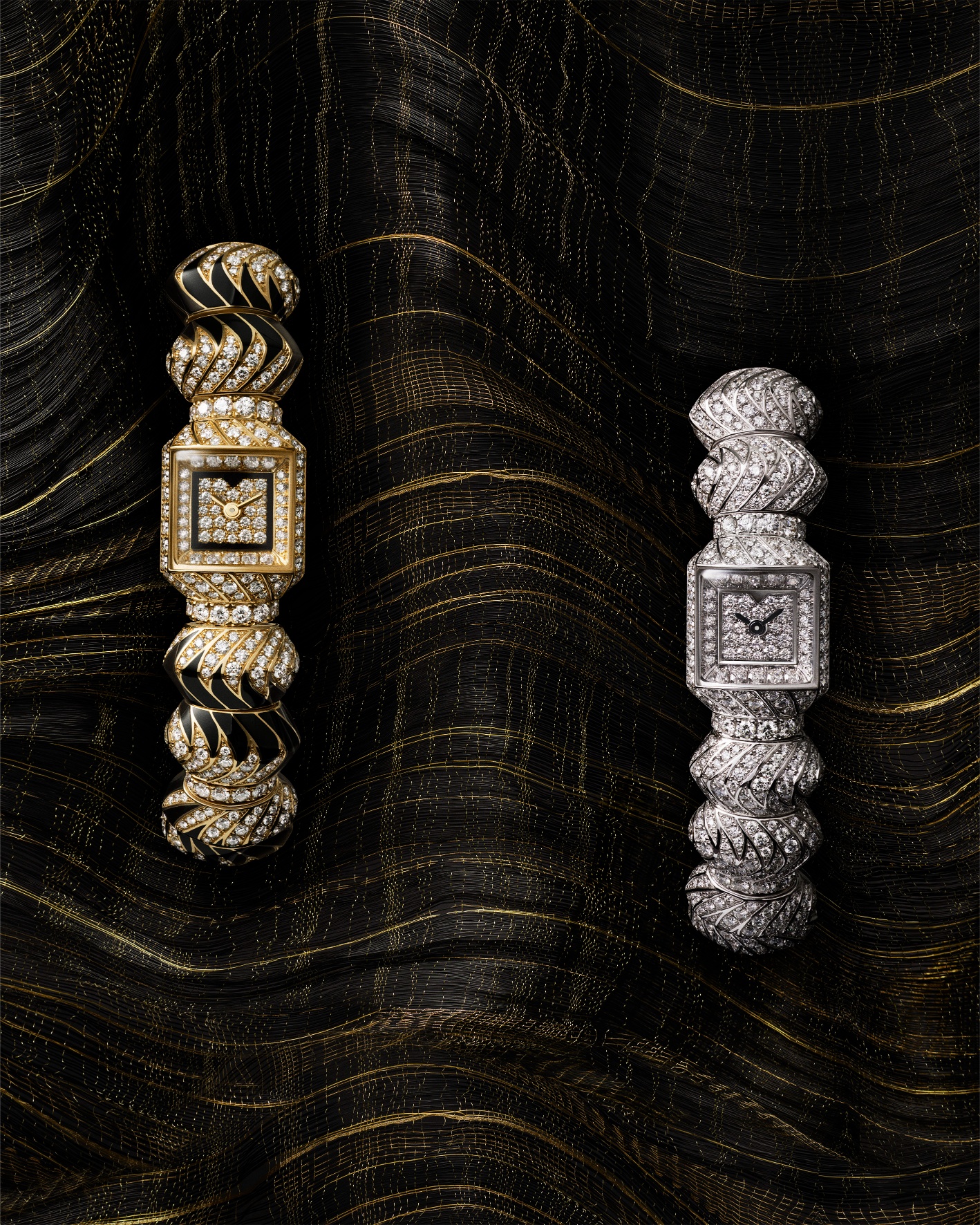
The yellow gold version features a case and bracelet set with 634 brilliant-cut diamonds (6.13 ct) with hand-painted black lacquer lines, and a dial paved with 47 snow-set brilliant-cut diamonds (0.35 ct) surrounded by an onyx frame. The bead setting on the bracelet uses stones of different sizes to create perspective and volume, requiring 30 hours of setting work. The lines of black lacquer were painted one by one by hand by an artisan at the Maison des Métiers d’Art in Switzerland.
A second version in white gold eschews the lacquer entirely, covering the same construction in diamonds — 986 brilliant-cut diamonds (9.17 ct) on the case and bracelet, and a dial paved with 45 snow-set brilliant-cut diamonds (0.37 ct). In this monochrome version, curves and forms appear and disappear depending on the angle of light. Both references share the same dimensions: 19.7 x 15.4 mm, thickness 9.9 mm, quartz movement, water-resistant to 3 bar, available in sizes 15 or 16.
Cartier Privé — Les Opus: The Tenth Edition
Since 2015, Cartier Privé — Les Opus has offered collectors an annual contemporary reinterpretation of an iconic-shaped watch from the Maison’s heritage. Past editions have centred on the Crash, the Tank Cintrée, the Tonneau, the Tank Asymétrique, the Cloche, the Tank Chinoise, the Tank Normale, the Tortue, and the Tank à Guichets. For its tenth opus, the Maison does something unprecedented: rather than focusing on a single shape, it celebrates three of the most emblematic watches from previous editions simultaneously — the Tank Normale, the Tortue Chronographe Monopoussoir, and the Crash Squelette — united by platinum and the chromatic pairing of platinum with burgundy.
The Tortue Chronographe Monopoussoir is a reinterpretation of a model from the Collection Privée Cartier Paris, created in 1998. It scales up the case to an XL format while reinterpreting the beaded hour-markers, rail track, and triangular dial corner motifs of the original. The movement is the Manufacture 1928 MC, a single-button chronograph in which start, stop, and reset are all condensed into one push-button integrated into the crown. At 4.30 mm thick, it is Cartier’s thinnest chronograph calibre. The movement’s Côtes de Genève finishing, shaped to follow the curves of the bridges, is visible through the sapphire crystal caseback. The watch is in platinum, with a silvered opaline dial with a burgundy minute track, rhodium-finished applied hour markers, and a semi-matt burgundy alligator strap. Dimensions are 43.7 x 34.8 mm, thickness 10.2 mm, water-resistant to 3 bar.
The Tank Normale in platinum echoes a 1934 model, fitted with a seven-row platinum bracelet and a white gold folding buckle. The brushed finish on the case and bracelet is set against polished metal on the edges of the brancards and the rim of the case. The silvered opaline dial features burgundy Roman numeral hour markers and blued steel hands. Dimensions are 32.6 x 25.7 mm, thickness 6.85 mm, mechanical movement with manual winding.

The third piece in the triptych is the Crash Squelette, the watch that inaugurated Cartier Privé in 2015, and here receives an entirely new skeleton treatment. Created in 1967 in London, the Crash has always been produced in highly exclusive series. The new Manufacture 1967 MC movement with manual winding has been specially developed to fit the Crash’s singular asymmetrical form, housing all 142 components in the smallest space possible. The movement’s bridges are shaped in the form of Roman numerals — a Cartier-patented construction — and have been entirely hammered by hand, a technique requiring nearly two hours of high-precision work per piece. The distortion of the case appears accentuated, as if the crown has pulled the movement downward. The Crash Squelette is produced as a numbered limited edition of 150 pieces, in platinum with a semi-matt burgundy alligator strap. Dimensions are 45.34 x 25.18 mm, thickness 12.97 mm.
To mark this tenth opus, Cartier is also inaugurating Cartier Privé — La Collection, a new line that brings together iconic shaped watch designs from previous Privé editions under a unified set of codes: yellow gold cases, golden dials, blued-steel apple-shaped hands, manual mechanical movements and dark grey alligator straps, each case back engraved with a stylised rendering of the watch shape. For this first act, three watches are presented — the Tank Normale (37 x 28.65 mm, 5.7 mm thick, horizontally satin-finished golden dial, black Roman numerals), the Cloche de Cartier (32.6 x 25.7 mm, 6.85 mm thick, golden grained dial, dark grey Arabic numerals) and the Tank Cintrée (23 x 46.3 mm, 6.95 mm thick, golden-coloured opaline dial, grey Roman numerals, Manufacture 1917 MC movement, water-resistant to 3 bar) — all in yellow gold with dark grey semi-matt alligator straps and manual mechanical movements.
Images: Courtesy brand