


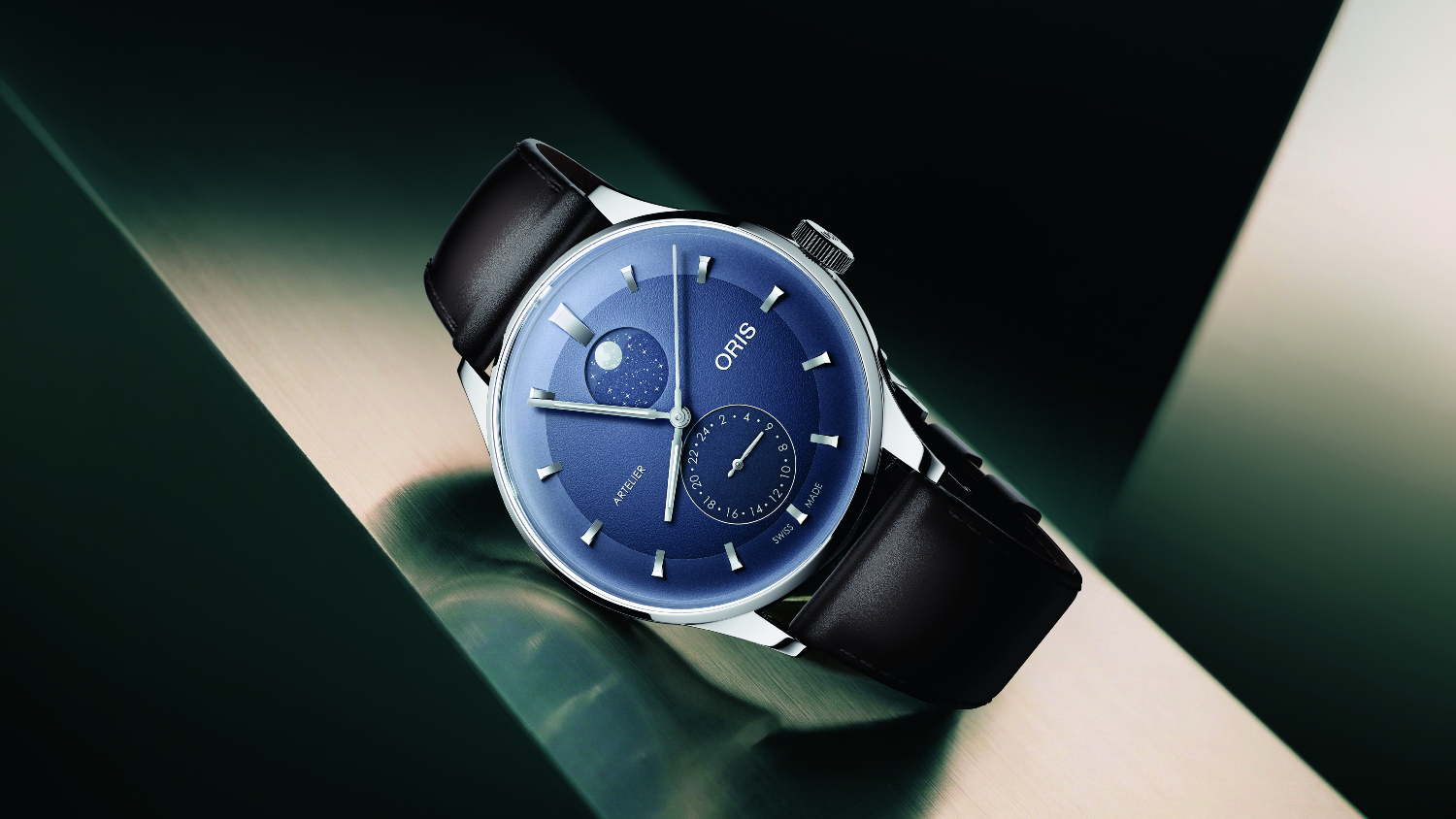
Oris is arriving at Watches and Wonders 2026 with two releases that sit at opposite ends of the brand's personality: one a forward-looking redesign of a beloved complication watch, the other a faithful revival steeped in a remarkable chapter of Swiss horological history.
The Artelier Complication with a cleaner dial, a new calibre
The Artelier Complication returns redesigned from the ground up with a cleaner, more urban sensibility. The redesign is the work of Lena Huwiler, Oris's Product Design Engineer, who is just 24 years old and joined the brand in 2024 fresh from her industrial design degree in Basel. The most consequential decision she made was also the most reductive: reducing the dial's sub-counters from four to two.
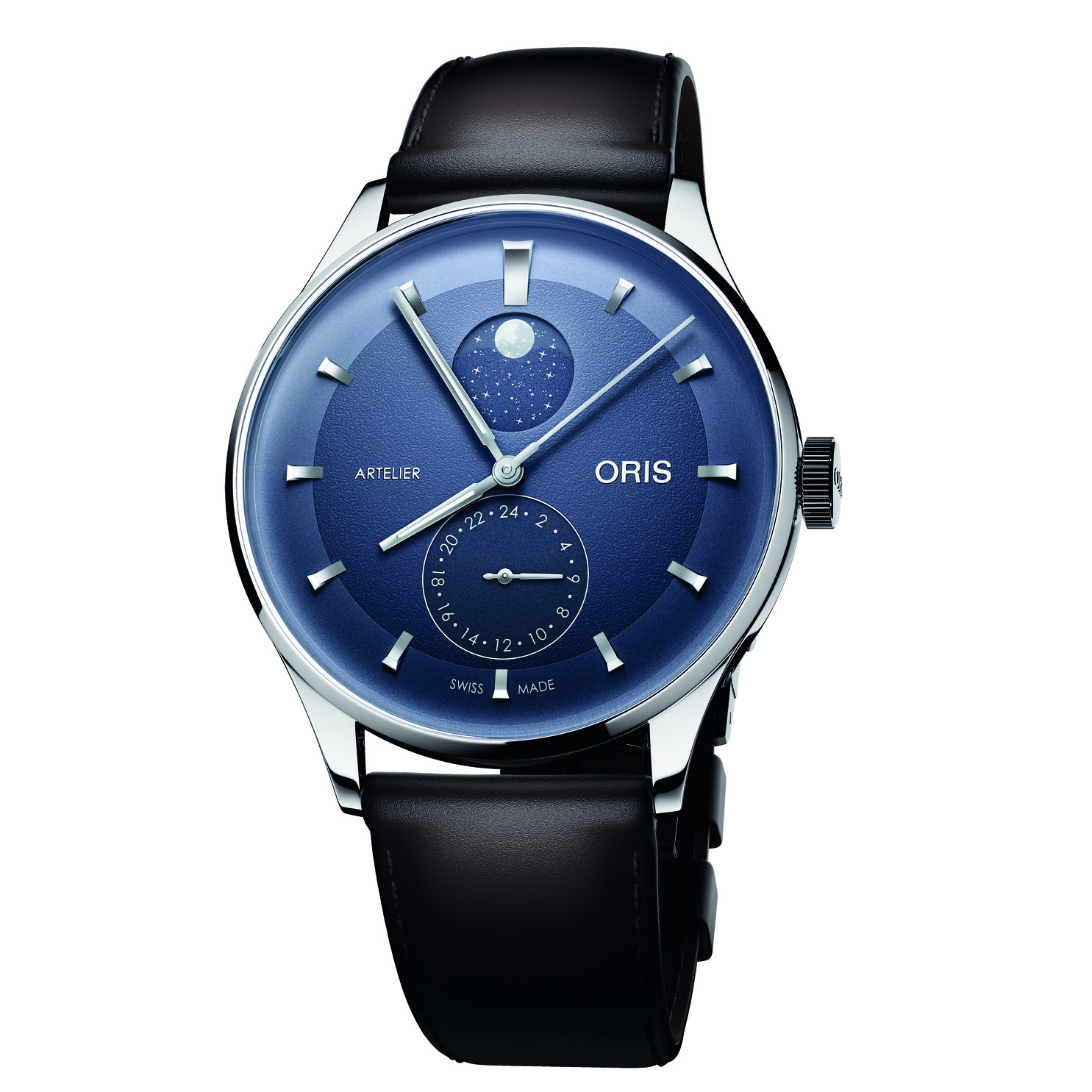
The new model retains only a moon phase at 12 o'clock and a second 24-hour time zone at 6 o'clock. This was made possible by the new Calibre 782 automatic, which shares the same base architecture as its predecessor, Calibre 781, but has had the gearing for the additional indications removed. The result is a 41-hour power reserve and a dial that breathes. Adjustments are managed through the crown and a single pusher integrated between four and five o'clock on the case flank.
The dial is divided into three zones: a textured centre, a smoothly curved outer rim, and the two sub-counters. Huwiler paid particular attention to the moon phase aperture – a shape that can often appear out of place on a dial because its cut-off semicircle form doesn't carry through to the rest of the design language. Her solution was to embed it within a circular starry sky that matches the colour of the aperture cover, visually absorbing the baroque form into the overall composition.
The second time zone counter at 6 o'clock mirrors this circular language, balancing the layout. A domed sapphire crystal, anti-reflective coated on the inside, sits over the whole arrangement. Further details reinforce the modernist intent: tapered and stepped hour markers, square-tipped hour and minute hands filled with Super-LumiNova, and a new sans serif typeface for "Artelier" and "Swiss Made."
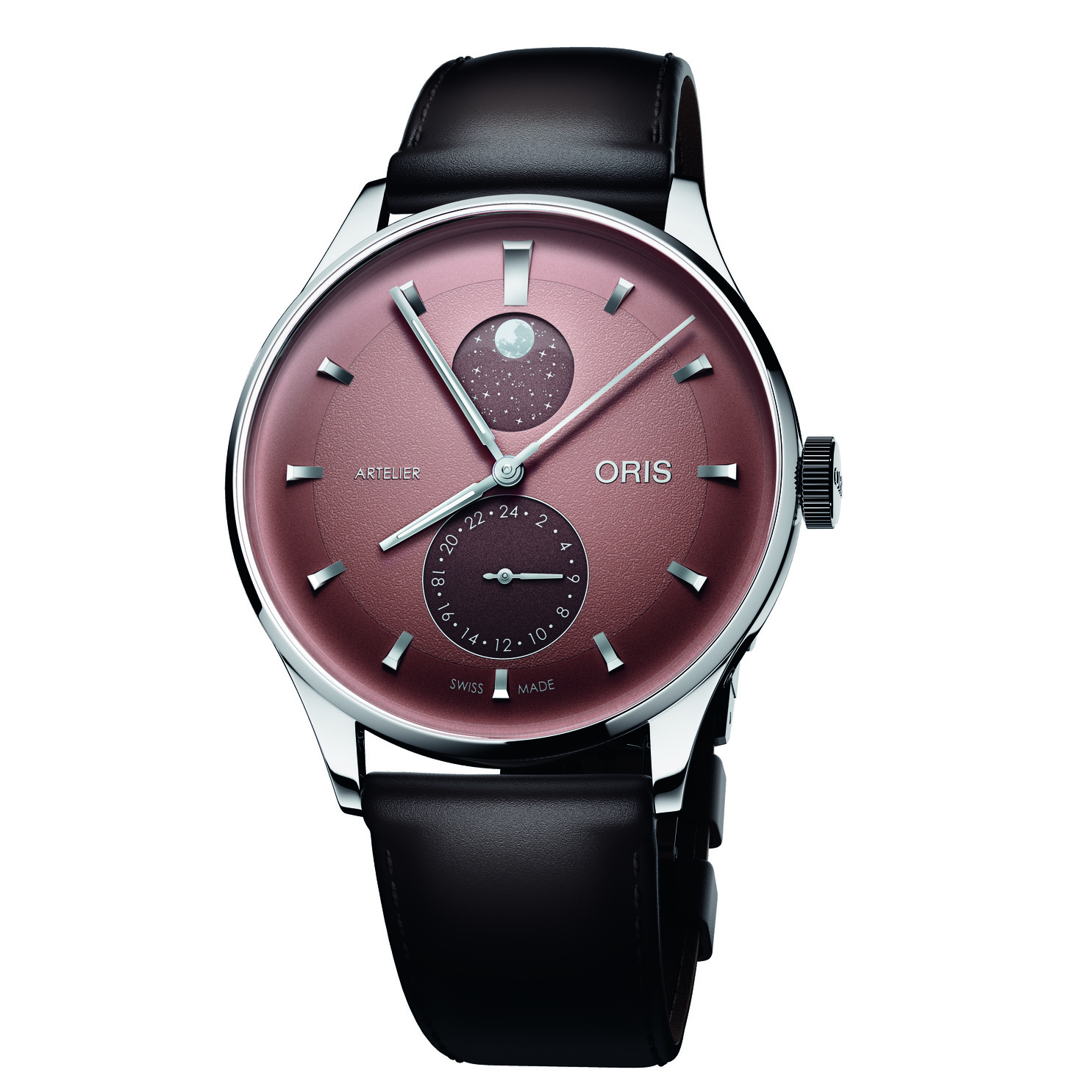
The watch measures 39.50 mm in diameter, 11.80 mm thick, and 45.50 mm lug to lug, in a multi-piece stainless steel case with a screwed caseback featuring a see-through mineral glass. It is available in three dial colours – ivory, midnight blue, and chestnut – each on either a dark brown leather strap or a stainless steel bracelet, both with butterfly clasps. Water resistance is rated to 3 bar.
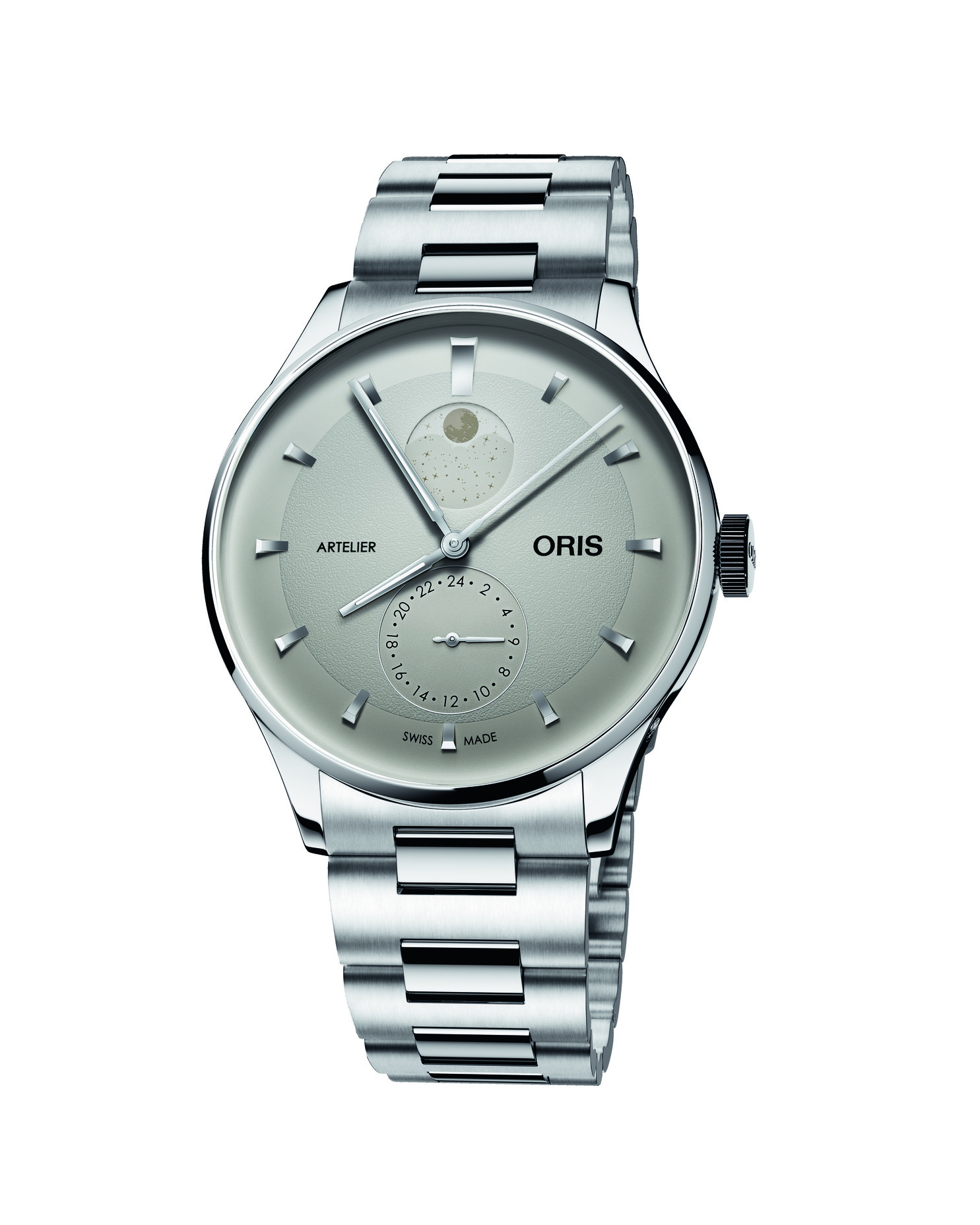
Swiss retail pricing is CHF 2,300 on strap and CHF 2,500 on bracelet, with availability from May.
The Star Edition 60th anniversary comes with an extraordinary backstory
The second Oris release at this year's fair is rather more unexpected, and its story begins not in a design studio but in a courtroom. The Oris Star Edition is a revival of the original Oris Star of 1966, a watch that was itself the direct product of one of the most consequential legal battles in Swiss watchmaking history.
For over three decades, the Swiss watch industry operated under the Swiss Watch Statute, a protectionist law introduced in 1934 in the wake of the Great Depression. Among its unintended consequences was that it effectively prohibited Swiss watch companies from innovating, restricting Oris, among others, to less precise pin-lever movements, a constraint enforced by a lobby of established manufacturers with little appetite for competition.
In 1956, Oris hired a young lawyer named Dr Rolf Portmann with a single brief: get the statute reversed. He spent nearly a decade fighting what the brand calls the "Swiss Watch Cartel." In 1965, he succeeded, and the law was scrapped, ensuring Oris was free to innovate. A year later, the company introduced the original Oris Star: its first watch with an in-house lever escapement movement. Dr Portmann later staged a management buyout of Oris in 1982 alongside Ulrich W. Herzog and remains Honorary Chairman. He is now in his nineties.
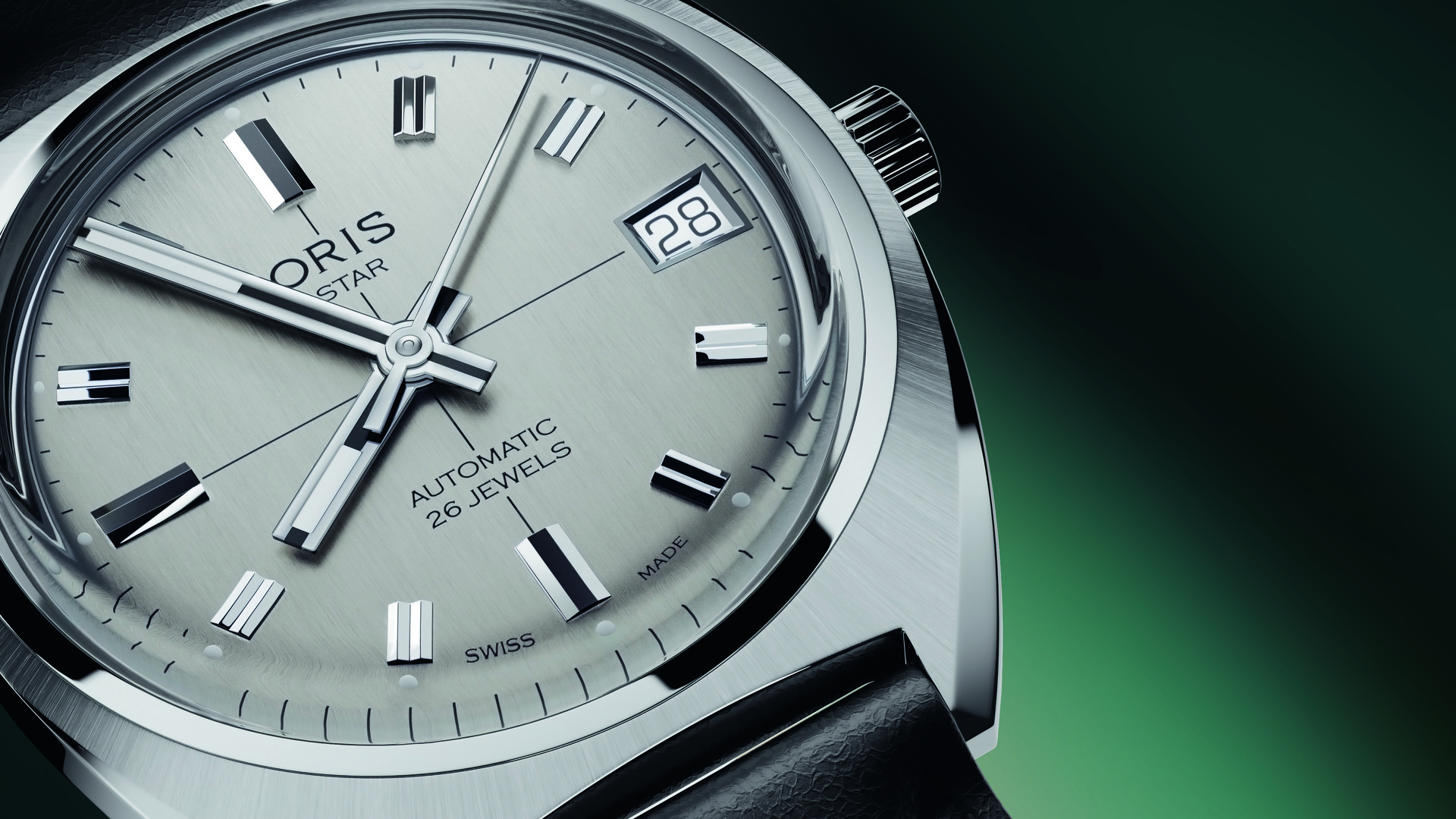
The new Oris Star Edition honours that moment sixty years on. Visually, it is a faithful revival of the 1966 original. The 35 mm barrel-shaped case has lugs seamlessly integrated into its silhouette, just as the original did. The silvery dial is sparsely decorated with twin-baton hour markers and square-tipped hands. Like the 1960s version, the words "Star", "Automatic", and "26 Jewels" appear on the dial alongside an asymmetrical date window at 3 o'clock. The finishing touch is a vintage plexi-crystal over the dial, and the caseback carries an engraving of the evocative 1960s Oris Shield crest. It wears on a black leather strap with a pin buckle.
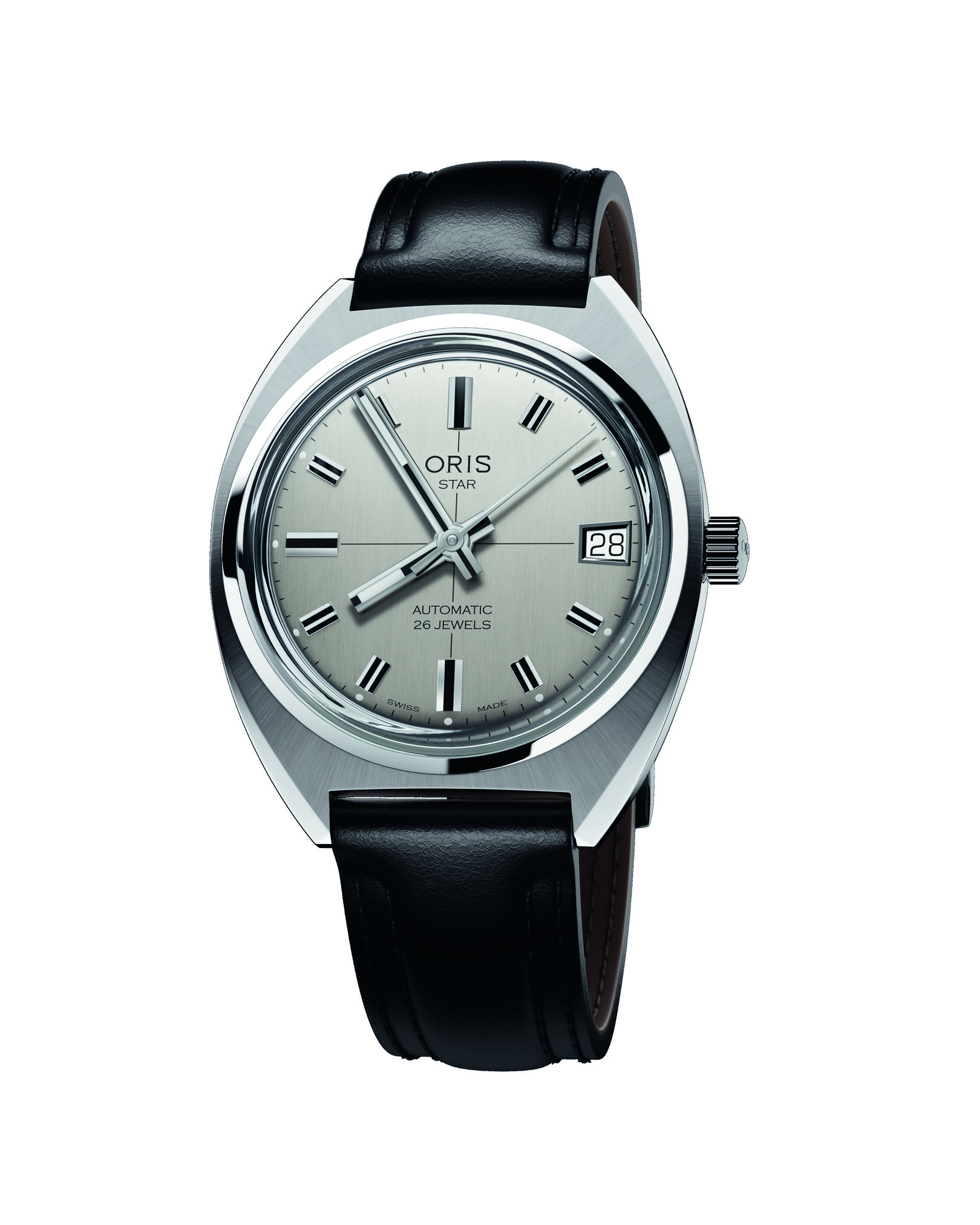
Inside is Oris Calibre 733, a Swiss-made automatic with a 41-hour power reserve, stop-second function, and instantaneous date. The case measures 35 mm in diameter, 11.10 mm thick, and 41.50 mm lug to lug, with water resistance to 5 bar.
The Star Edition will enter the permanent collection and be available in stores from May at a Swiss retail price of CHF 1,800.
Images: Courtesy Brand
Also Read :
Oris brings back the Big Crown Pointer Date “Bullseye”
|
Oris presents a limited edition of its Artelier Calibre 113 dedicated to the Year of the Horse
|
Oris joins hands with Changjiang Conservation Foundation for a special Yangtze Jiangtun Limited Edition
More In news


Sign up for our newsletters to have the latest stories delivered to your inbox
