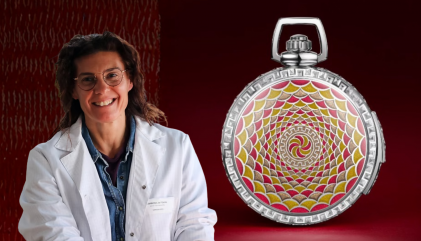
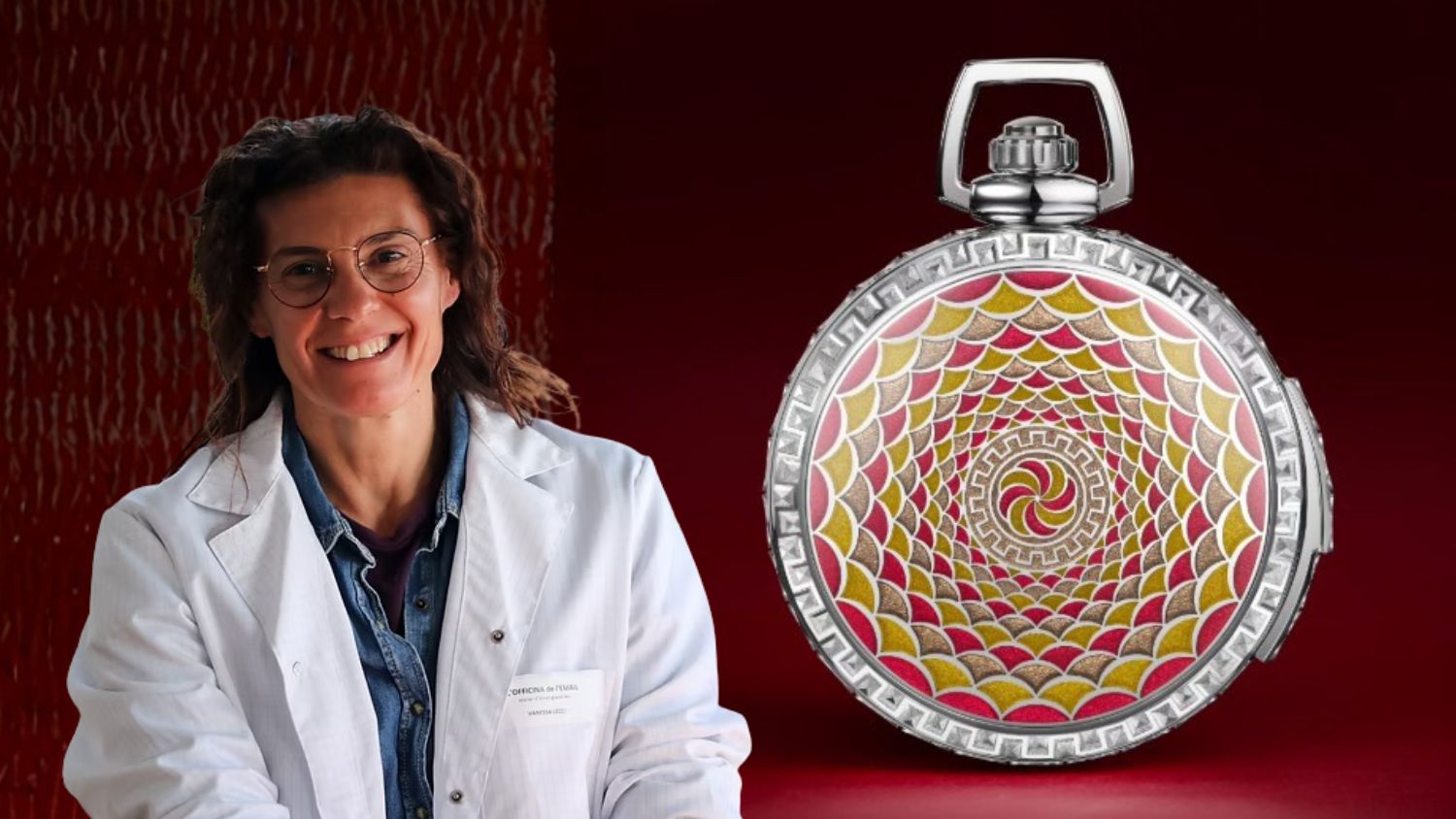
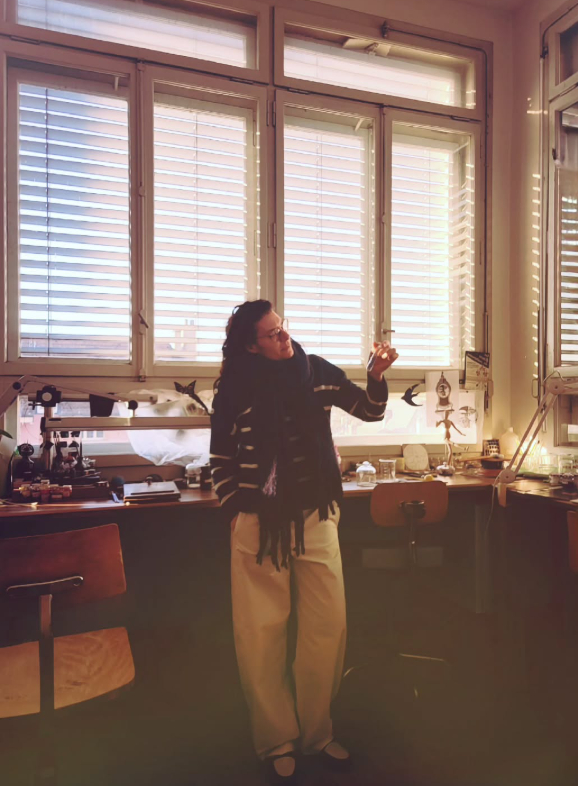
Independent grand feu enameller Vanessa Lecci has been working for some of the most prestigious Swiss watch brands. She is, for example, the artist behind such one-of-a-kind pieces as the L'Armoriale pocketwatch and the Parmigiani Fleurier Rosa Mystica. The Italian master enameller works in Peseux in what she calls her "own small kingdom," the Officina de l'Émail, and quickly learned that the art of enamelling wouldn't be possible without the constant search for good colours, often stemming from long-gone manufactures.

This story first appeared in WatchTime India's Watches for Women 2026 issue in print
Images: Courtesy Instagram/ vanessalecciatelier
In theory, enamel is simple glass elevated to its greatest exponent through fire, metal oxides, and the expert skill of a master craftsman, or in this case, a craftswoman, who, like Vanessa Lecci, is dedicated to preserving and perfecting this centuries-old art. In reality, only a handful of traditional manufacturers were able to preserve the art of enamelling, and there are only a few places that teach it today. What's worse, the choice of raw materials is increasingly restricted by the dwindling number of glass manufacturers.
In addition, not unlike the unmatched quality and precision of vintage guilloché machines, today's colours cannot always keep up with the quality of enamel colours from the past. Lecci says, "Fortunately, I started 25 years ago to search for my colours and pick up stock. The last stock I was able to find, and I love telling this story, actually came from a convent of nuns."
The shade and quality of a colour depends on the addition of different metal oxides, like cobalt for blue, copper for red, and zinc for yellow. In the first step, glass Vanessa Lecci, independent grand feu enameller has to be crushed into a very thin powder, then washed. Once this mixture is applied, it has to be fired in the kiln at a temperature of 800° C. The enamel is usually layered four or five times, and every time it has to be fired again, potentially endangering hours, weeks, or even months of work that came before. At the beginning of every project Lecci takes on, a colour palette has to be developed, together with the client. The project is then solely dependent on finding the 'right' colour, knowing that the base material and depth of engraving will also have an impact on the final and usually very finite result. But not only that, "If I ask you to describe, to define the colour, we'll have one, three, five, six different definitions of this colour," she says.

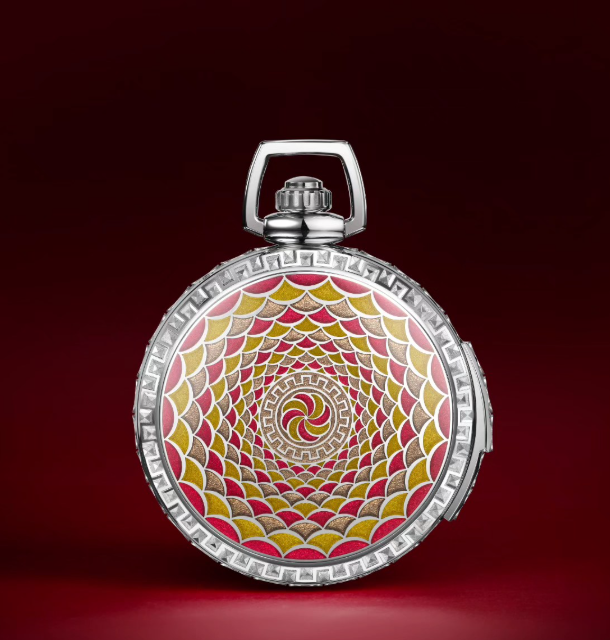
For the 18-karat white-gold caseback of Parmigiani's L' Armoriale, for example, the patterns on the case were meticulously engraved, and each cavity was then filled with coloured translucent enamel in varying shades of red, yellow, or brown. This intricate technique, to quote Parmigiani Fleurier, created "subtle shades and a unique texture, bestowing upon the case a captivating visual depth." The enamel colours used on the dial were also part of this curated palette, featuring hues of yellow, red, and translucent brown. Each shade had to be perfectly balanced, creating a harmonious visual effect. Lecci says, "There is a limited number of old colours, and sometimes I only have enough for one piece. Unless, of course, I get called by another convent telling me to go and get it."
An experienced enameller like Lecci not only knows where to look for colours, but also from what period. Because, even if the manufacturer is still around today, like Austrian brand Schauer, their current colours might be produced in a different way, and old recipes are often lost forever.
Sometimes, she tries to improve the colour she had found in her own way to get as close as possible to the image in her head, and to make sure that there are as few bubbles in the enamel as possible. Lecci estimates that half of her time is dedicated to finding the right colours, the other half to the actual enamelling. "It's also a journey that you take with a brand; you have to give me the time to go looking, that's where I reach the nuances. It takes a certain amount of time; you have to see and test the quality. In those moments, I am like a kid waiting for the Christmas presents."
Lecci was born in the southeast of Italy. While she initially decided to come to Switzerland to pursue a career as a professional volleyball player, she later decided to study and specialise in gem-setting at the Geneva University of Art and Design. A few years later, Cartier approached her to set the stones for the CPCP collection (Cartier Paris Collection Privée); then she moved to La Chaux-de-Fonds, where she was asked to set up an enamelling atelier for the Maison. After that, Lecci moved on to Girard-Perregaux and also worked for behemoth Patek Philippe as an enamel artisan while developing her venture Officina de l'Émail. "I am always on the lookout for the right colour", she says.
This story first appeared in WatchTime India's Watches for Women 2026 issue in print
Images: Courtesy Instagram/ vanessalecciatelier
Also Read :
MeisterSinger’s new 24H Enamel is a limited edition of 25 pieces
|
H. Moser & Cie. introduces a new Streamliner Concept Minute Repeater Tourbillon Blue Enamel
|
Jaeger-LeCoultre's Reverso Tribute Enamel 'Tiger'
More In People & Watches




Sign up for our newsletters to have the latest stories delivered to your inbox