




As 2026 is here, several of watchmaking’s most influential brands and designs are reaching historic milestones. From Gérald Genta’s enduring icons to tool watches that reshaped the industry, these anniversaries tell the story of modern horology.
TURNING 50
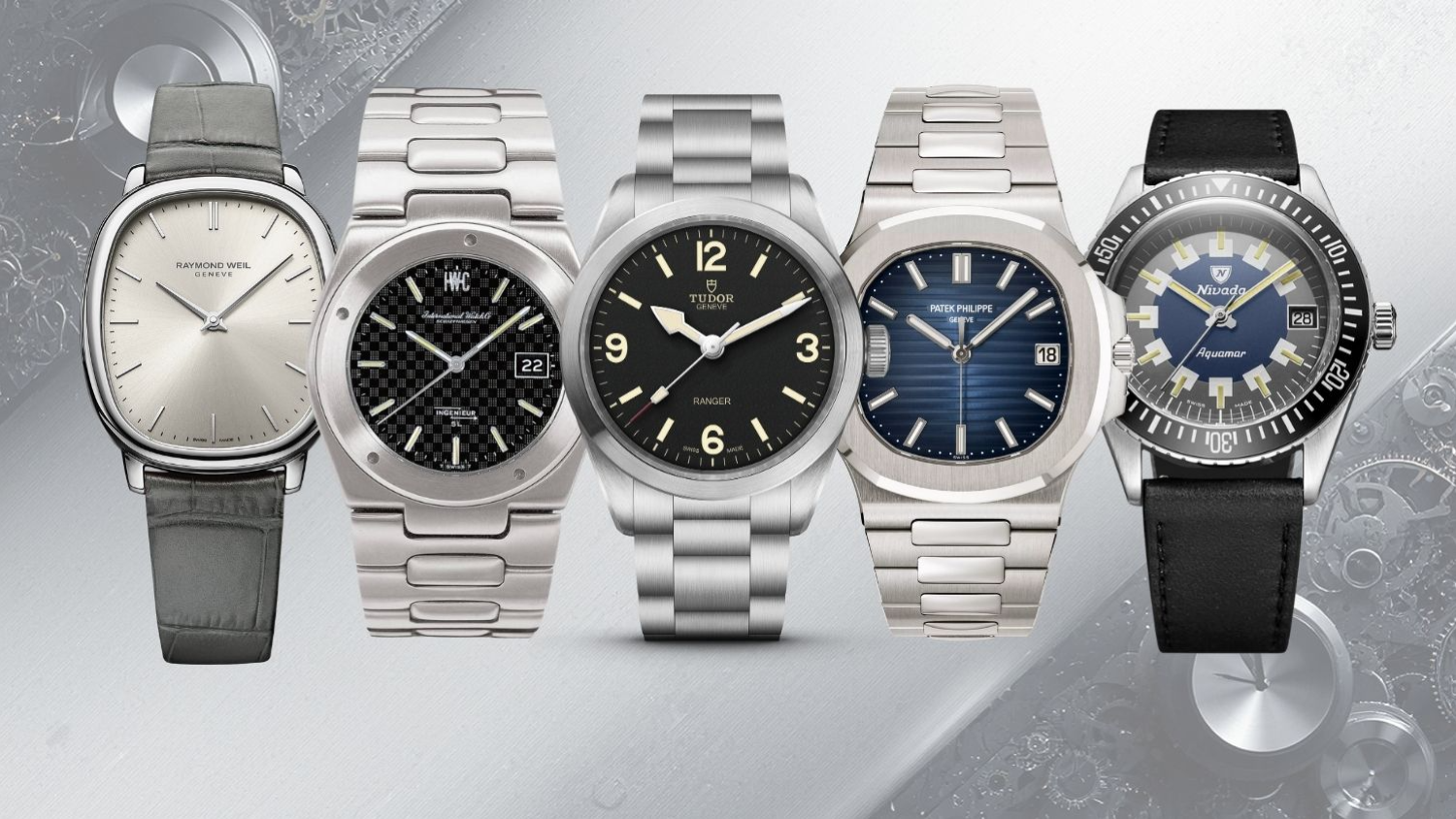
Raymond Weil
Founded in Geneva in 1976 by its namesake founder, Raymond Weil is one of the few independent, family-owned watch brands in the Swiss watch industry today. Founded during the height of the Quartz Crisis, the brand aims to create high-quality Swiss timepieces at a reasonable price point. Today, led by CEO Elie Bernheim, the past three years at the brand have seen a focus toward high-end mechanical craftsmanship, like the first complete calendar complication within the Freelancer collection, the introduction of a new vintage-inspired line called Millesime, and, most recently, a collaboration with the irreverent watch artist seconde/seconde/.

Patek Philippe Nautilus
Designed by Gérald Genta, who allegedly sketched it on a napkin in five minutes during the 1974 Basel watch fair, the Nautilus is one of the most iconic luxury sports watches today. Inspired by the portholes of transatlantic ocean liners, its distinctive features include a rounded octagonal bezel with ‘ears’ (lateral hinges) on the sides, an integrated bracelet, and a horizontally embossed dial. It is named after the fictional submarine in Jules Verne’s novel Twenty Thousand Leagues Under the Sea, and in 1976, it was marketed as ‘one of the world’s costliest watches made of steel’.

Gérald Genta’s first Ingenieur SL
Gérald Genta redesigned the Ingenieur, first introduced in 1955, and presented Ingenieur SL Ref. 1832 in 1976. It was designed as a professional-grade tool watch specifically for individuals exposed to strong magnetic fields. It featured a soft-iron inner case (a “Faraday cage”) to protect the movement against magnetic fields up to 80,000 A/m. It also housed IWC’s first in-house automatic Caliber 8541ES. In 2023, the brand launched Ingenieur Automatic 40 series, a direct homage to Genta’s iconic 1976 model.

TURNING 40
Rado
Rado’s Integral collection was launched in 1986, marking the first time Rado used high-tech ceramic in a watch. The line featured a distinctive sleek, rectangular design, departing from the traditional round cases prevalent at the time. Current models remain true to the original look, typically combining the signature high-tech ceramic with stainless steel elements, often with PVD coating for a bicolour look.

TURNING 200
Gallet
Formally established in 1826 by Julien Gallet in La Chaux-de-Fonds, Switzerland, the brand contributed to professional timekeeping with its chronographs and stopwatches used in aviation, motorsport, and by the military. Owing to the Quartz Crisis, the brand folded up its operations in the 1980s. In 2025, Breitling acquired Gallet and plans are underway to launch its revival in 2026, the 200th year of the brand.

TURNING 100
Tudor
Founded in 1926 by Hans Wilsdorf, also the founder of Rolex, to offer timepieces with the same reliability and quality as Rolex but at a more accessible price point, Tudor is today known for its robust tool watches and vintage-inspired designs. With a range of offerings, most popular among which is the Black Bay line, Tudor watches are characterised by their “snowflake” hands, high-performance in-house movements, T-fit clasps, and off late, bold colours.

Nivada Grenchen
Founded in Grenchen, Switzerland, by Otto Wüllimann, Hermann Schindler, and Jakob Schneider, and initially operating under the name Wüllimann, Schneider, Nivada SA, the brand’s goal was to produce reliable, high-quality Swiss tool watches at accessible price points. After years of dormancy due to the Quartz Crisis, it was revived in 2018 by French entrepreneurs Guillaume Laidet and Rémi Chabrat. The new owners are focused on creating modern, Swiss-made reissues of iconic vintage models like the Chronomaster, Antarctic, and Depthmaster.

Rolex Oyster
In 1926, Rolex unveiled and patented the Oyster case, the world’s first waterproof and dustproof wristwatch case. The name Oyster was chosen because the watch, like an oyster shell, could remain sealed and protected underwater. A key innovation in it was a system of screwing down the bezel, caseback, and winding crown against the middle case, creating a hermetic seal. In 1927, English swimmer Mercedes Gleitze swam the English Channel. After more than 10 hours in the water, the watch remained in perfect working order and created history. The watch worn by Gleitze was recently auctioned by Sotheby’s and fetched $1.73 million. This watch, along with the perpetual self-winding rotor (1931), served as the direct predecessor to the entire current Oyster Perpetual range.

Images: Courtesy Brand