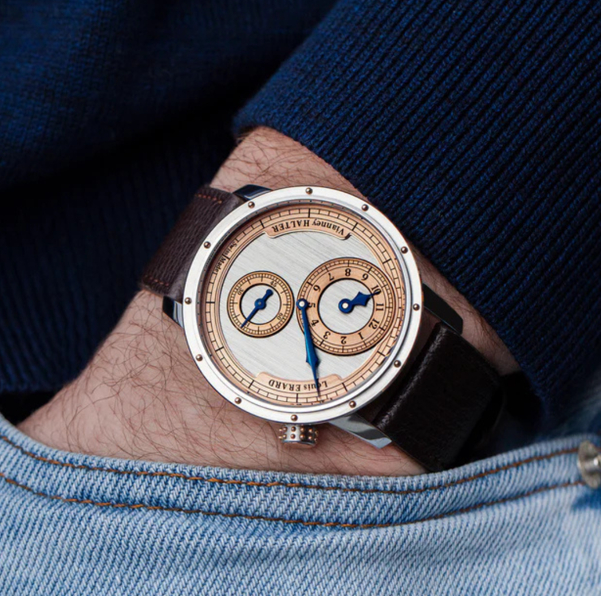
King of Steampunk. The Futurist. The Clockmaker from the Stars. These are a few of the monikers that Swiss independent watchmaker Vianney Halter has earned, thanks to the one-of-a-kind timepieces he has created. Another example of this is Halter’s collaboration with Louis Erard, which has resulted in the Le Régulateur Louis Erard X Vianney Halter II. Marking the second time that the two have joined hands (the first was in 2020, with the Le Régulateur Louis Erard x Vianney Halter), the new watch showcases a Steampunk craftsmanship, typical of the codes of Halter’s very first creation, the Antiqua, imagined for a regulateur complication that Louis Erard watches are known for.
The timepiece comes in two versions—a red-gilt dial base version with a rhodium-plated, circular satin-brushed chapter ring and counter ring (Ref. 85246AA03.BVA172), and the other a rhodium-plated dial base with a red-gilt, 5N-plated, circular satin-brushed chapter ring and counter ring (Ref. 85246AA02.BVA172). The novelties feature rivets on crown and case, and an asymmetric design like that of Antiqua. The dial at 11 o’clock shows the hour, while the central hand is for minutes, marked on the rehaut, and there’s a seconds subdial at 5 o’clock. The hands are blued steel, a signature of the watchmaker, and the markings are black. Louis Erard’s logo is at 2 and Vianney Halter’s name is at 8 o’clock. Limited to 178 pieces each, the watches are powered by the automatic Sellita Calibre SW266-1, with a power reserve of about 38 hours.
As mentioned, the watch derives from a previous Halter signature, the Antiqua Perpetual Calendar created in 1998, which was the first watch that he built under his independent label, which the watchmaker had established four years earlier. The design of the timepiece was so atypical that it was regarded by many as a “relic from the future”. To bring the Antiqua to life, Halter took inspiration from marine chronometers and created a contemporary wristwatch with a unique case shape and dial that was distinguished by four riveted portholes, which had hand-engraved gold dials where complications were arranged. Encased in 40mm x 40mm x 11.3mm platinum, the biggest dial displayed Arabic hour markers and railway track minutes; the one opposite it had a month and leap year indication; the single-hand dial showed the day of the week; and the smallest one, the date. Rivets feature on the dial plate, crown, and on the periphery of the see-through caseback. The case was made of 130 parts (including the 104 rivets), each part refinished and decorated by hand. Through the sapphire caseback what was visible was the seemingly simple-looking, in-house Calibre VH198, built on a double-barrel Lemania 8810 base, reimagined by Halter for Antiqua. The movement beat at 28,800 vph and provided a power reserve of about 35 hours, thanks to its ‘mystery’ peripheral rotor, also sporting rivets.
Antiqua set the pace for everything one could expect from Halter in the coming years. In 2003, he collaborated with American luxury jewellery and watchmaking brand Harry Winston on the Opus 3, a 36mm x 52.5mm x 13.7mm mechanical-digital masterpiece with six portholes to read hours, minutes, and the date. The hours were read horizontally on portholes 1 and 3, and the minutes on portholes 4 and 6, and the date read vertically on 2 and 5. The first aperture also showed a four-second countdown to the final four seconds of every minute. The watch won the Innovative Price at the Grand Prix d’Horlogerie de Genève (GPHG) the same year.
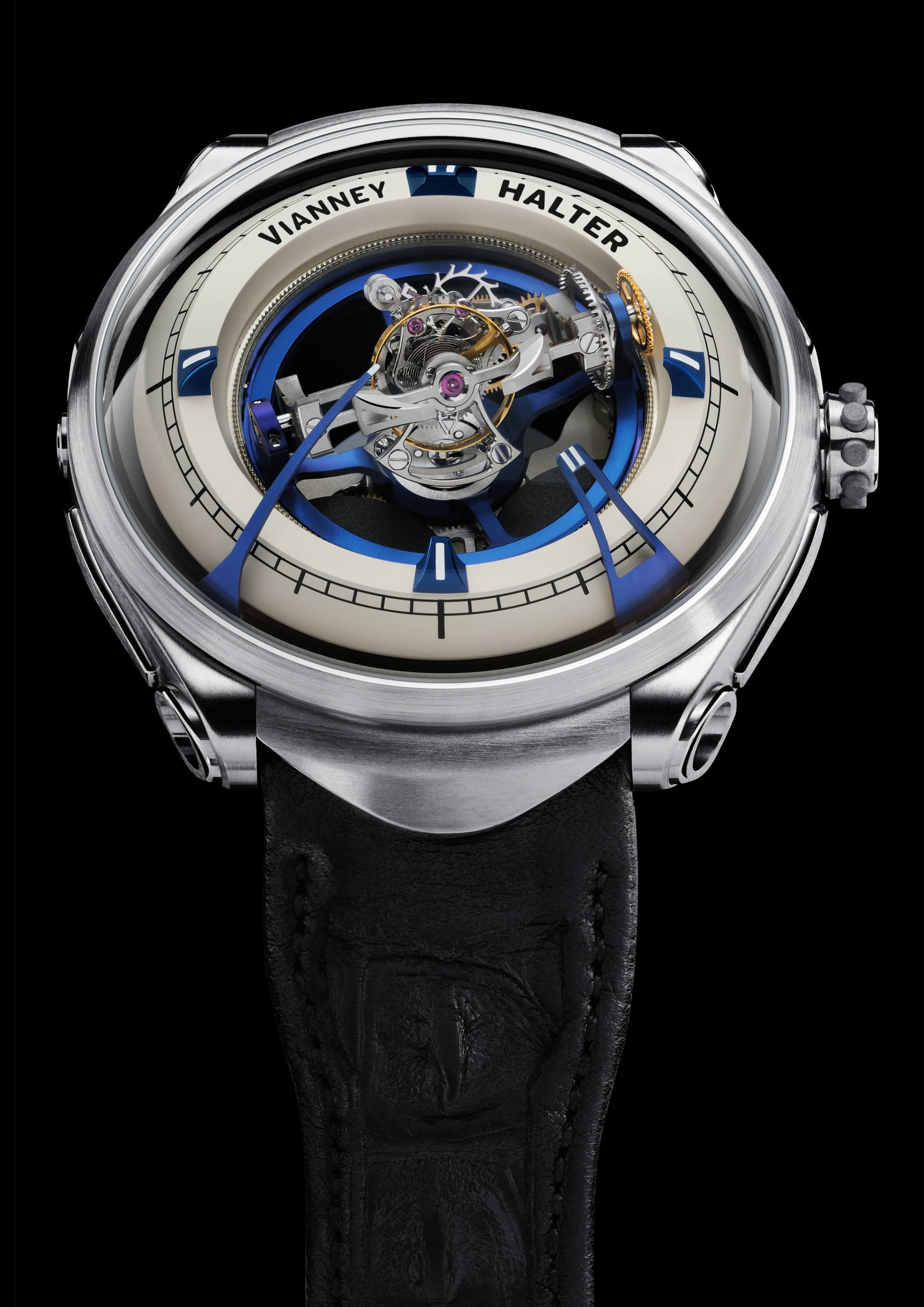
The other Halter work that startled people in the watch industry was The Deep Space Tourbillon released in 2013. Six years in the making, Halter has described the 46mm x 48mm x 20mm titanium piece as “the four dimension watch for deep space voyagers”. Its highlight was the triple-axis central tourbillon revealing the in-house movement VH113, inspired by space exploration—the tourbillon rotated at three different speeds, with one axis completing a turn in 40 seconds, another in six minutes, and the third in 30 minutes, revealing a complex mechanism. Time was displayed by two curved-blued titanium hour and minute hands which surround the tourbillon. The same year, this watch won the GPHG prize for Design & Innovation.
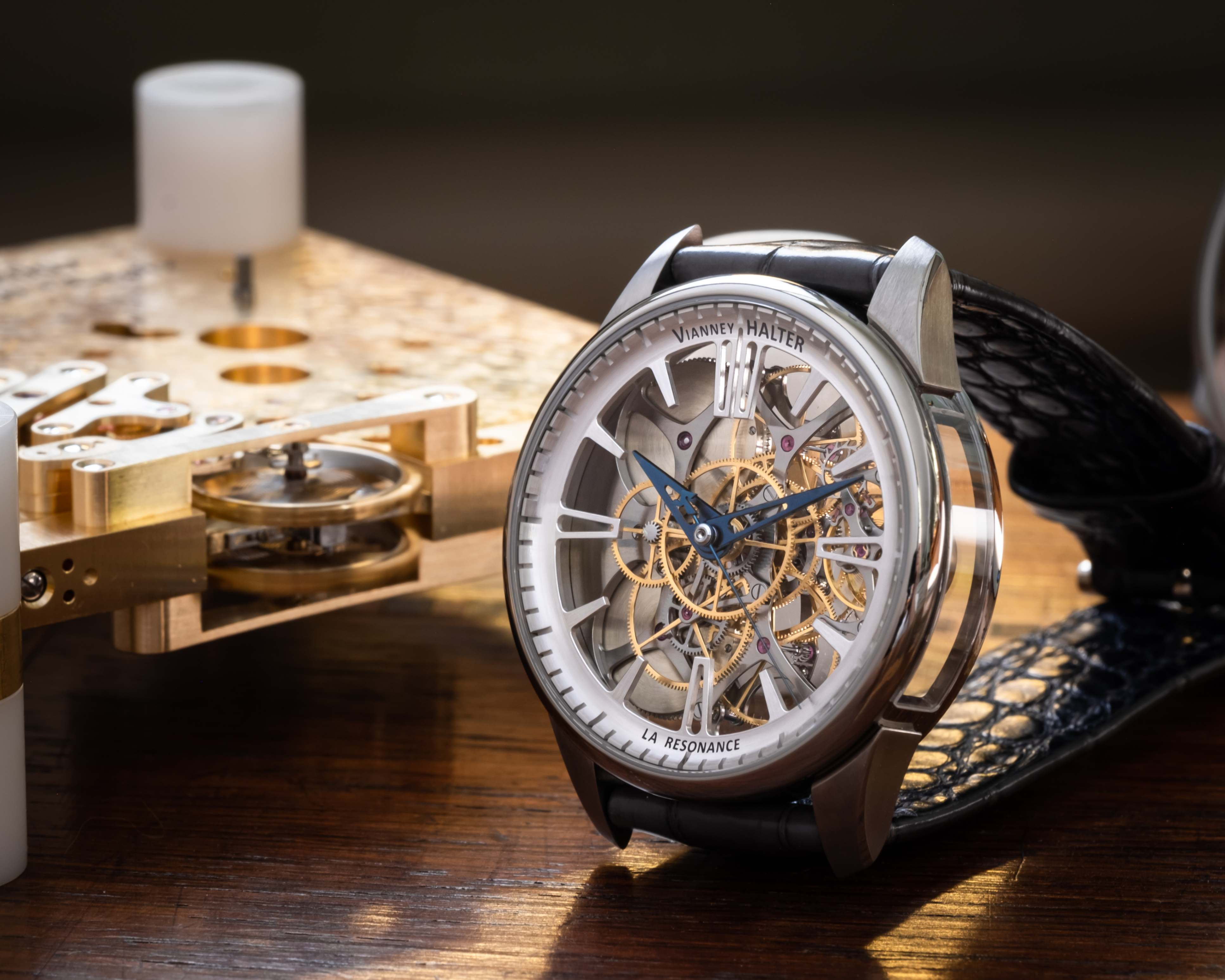
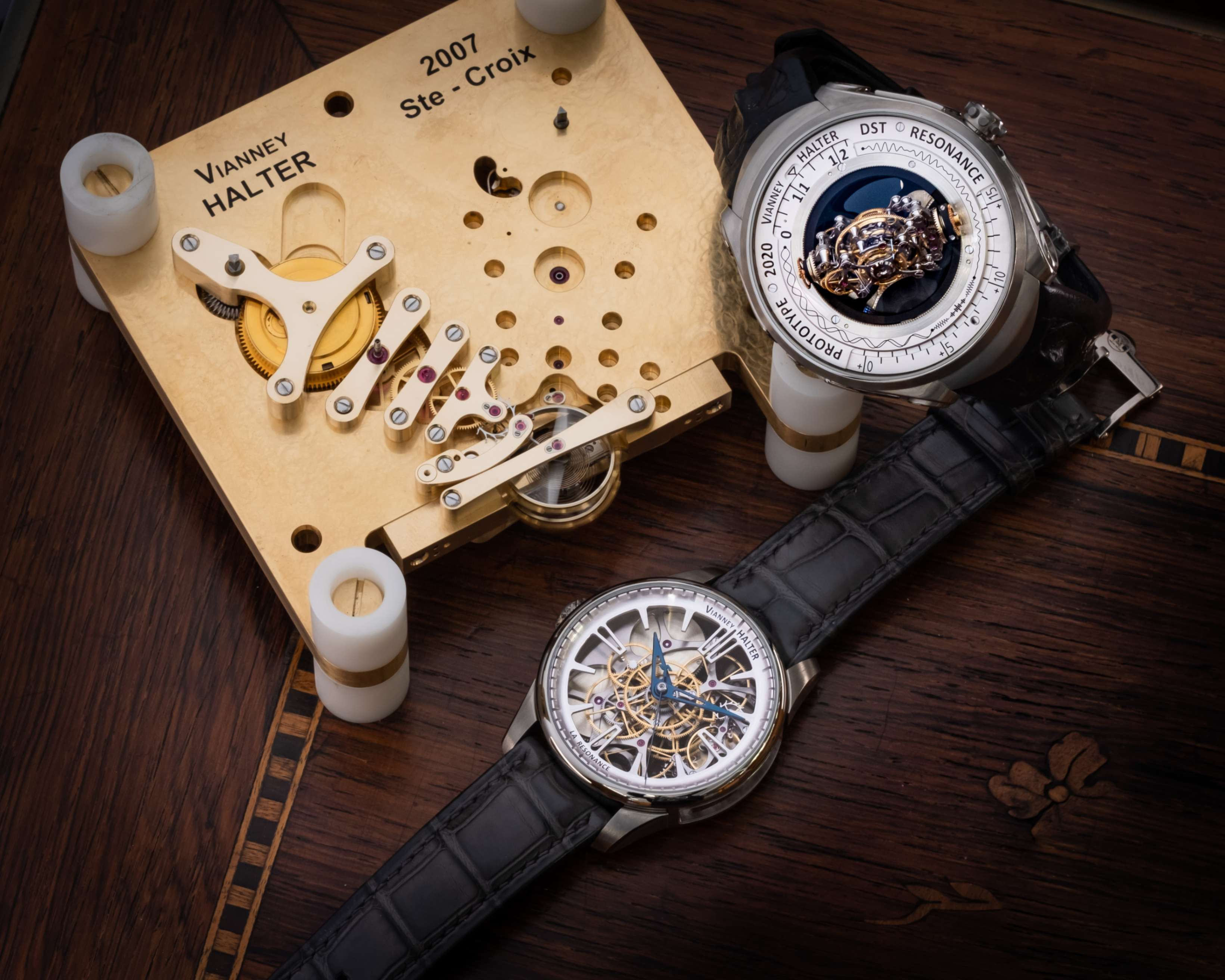
Halter’s Deep Space Resonance and La Resonance, which were released in 2021 and 2022 respectively, also proved to be marvels that have come to define his oeuvre. For the Deep Space Resonance, he reengineered the three-axis tourbillon by integrating two acoustically synchronised balance wheels—the balance wheels are connected in such a way that they get synced and beat together, thus making the movement more accurate. This phenomenon is called resonance. Inspired by the Vernier calliper, a tool that measures the dimensions of an object, the dial is easy to read. The hours are shown in the top aperture and minutes in the bottom aperture by finding where the marks match the best. The watch has 65 hours of power reserve. In La Resonance, the watchmaker omitted the traditional mainplate. The timepiece is regulated by two oscillators coupled by acoustic resonance and the in-house developed Caliber VH222 is visible through the dial as well as from the 3 o’clock side of the case, from where the oscillators can be seen. The crown is also moved to 9H, for a better view of the mechanism. The 39mm timepiece is crafted in titanium.
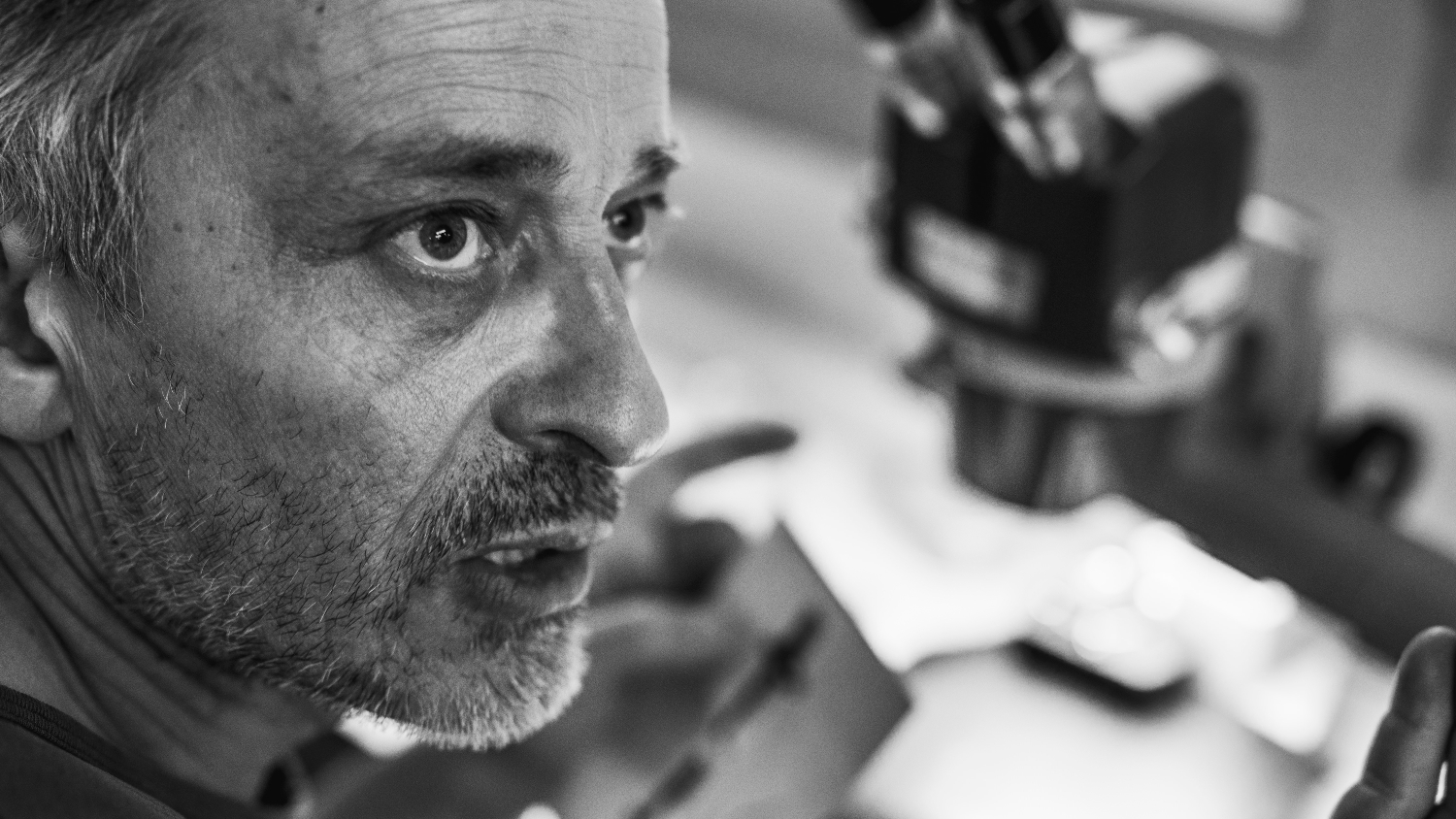
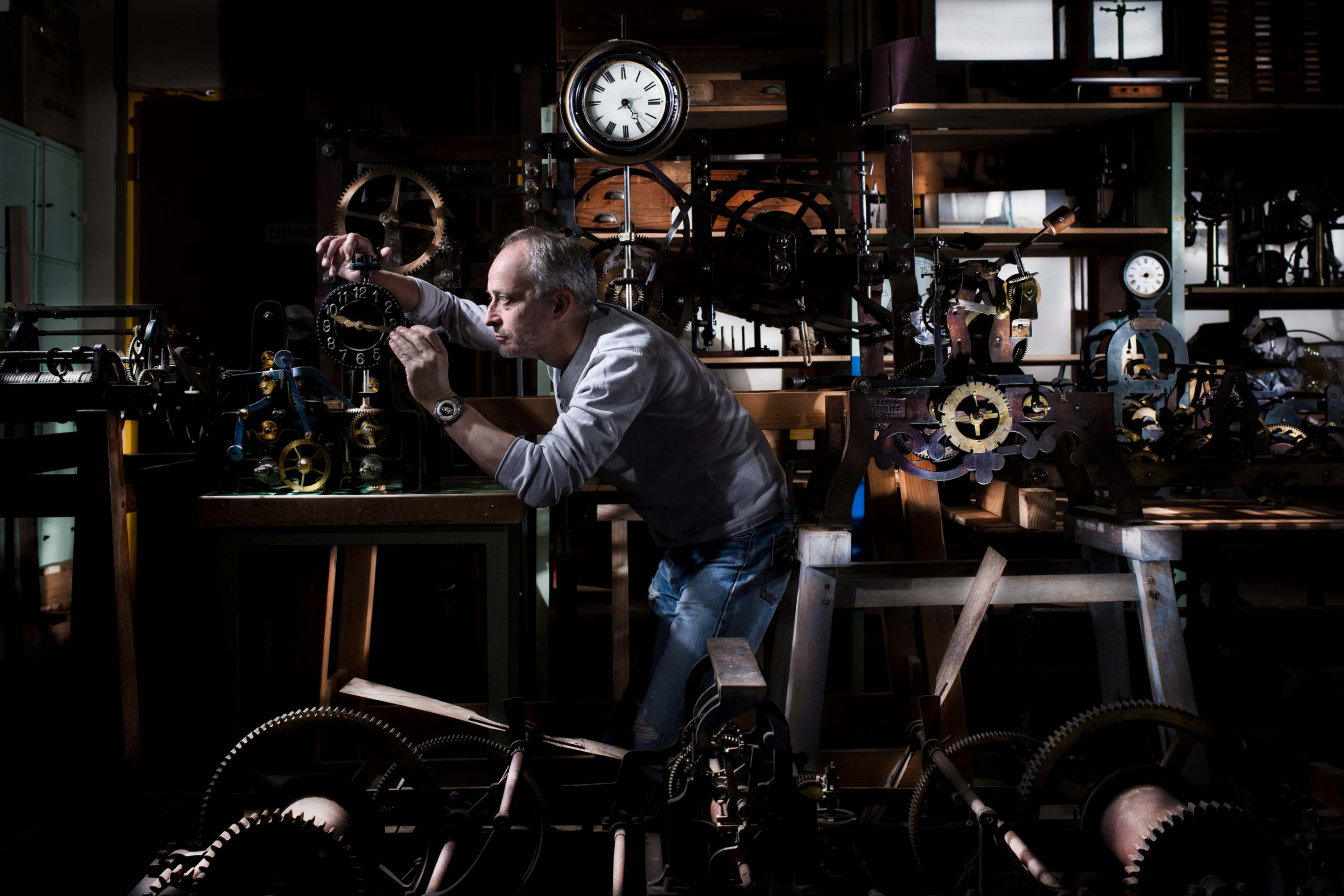
Halter was born in Suresnes, a suburb of Paris, in 1963. His father, a train driver for the French National Railways, would bring home old machines and mechanical parts, which curious Halter would explore. “As far as I remember, I have always been doing mechanics. As a child, I dreamt of understanding, designing, and crafting wacky mechanical items. My creations speak my mind and thanks to them, I can share my universe with other human beings,” Halter says on his website. Beginning his watchmaking journey at the age of 14, he enrolled himself at the Ecole Horlogère de Paris. He graduated in 1980. The first decade of his professional life was spent restoring pendulum clocks and other horological pieces.
At GPHG 2011, when Halter won his first major award of ‘Meilleur Horloger-Concepteur’ (Best Watchmaker-Designer), he said, “Watchmaking is an exploration journey,” which has been proven every time with his new concepts. We spoke to him about his mechanical thinking, design inspiration, collaborations and more….
WatchTime India: How has the association been with Louis Erard?
Vianney Halter: Both collaborations were very smooth and easy. The Louis Erard team is young and dynamic.
WTI: What is the easiest and most challenging part about collaborating with a brand?
VH: The easiest is to agree on a design and a technique; it is more complex to find a
fair agreement.
WTI: You have made watches with unique shapes and designs, like Antiqua, Satellarium, Cabestan, and more. What is the draw of shaped watches for you?
VH: As a watchmaker, working on both mechanism and design (i.e. case, dial, mechanical aesthetic), allows me to express myself by giving a deep point of view on watchmaking and artistic creation.
WTI: Your watches are described as a fusion of tradition and futurism. How do you balance these?
VH: Using the knowledge I have inherited from my Master and using our ancestors’ techniques, while using them through the prism of my point of view about the future—this gives the balance between both aspects.
WTI: When you start a new watch project, what is the first thing you envision? The mechanics, the aesthetic, or the story behind it?
VH: It starts with something that occurs in my own life. That gives rise at the same time to both aesthetics, drawings, and technical research and development, in order to give a translation of what I have in mind into a watch project, to tell something. This starting point can either be an experience of life, a book that I have read, a movie that I have watched, an architectural inspiration, or, last but not least, an encounter.
WTI: What is the one design philosophy that all your watches follow?
VH: To stretch the limits of the realms
of possibility!
WTI: In your watchmaking journey, what has been the most significant way that your work has evolved?
VH: The most significant way of the evolution of my work is to have developed technical systems, which have been more sophisticated and innovative.
WTI: When you create a watch, do you design keeping collectors in mind, and how much of it is just pure creativity?
VH: My creations emerge only from free creativity. I hardly ever [adhere] to the collectors’ requests.
WTI: You do all the operations by yourself for better quality of your creations. In the future, do you hope to increase the number of watches you make?’
VH: I do not specially feel like increasing the number of pieces I make. I will rather improve again the quality of my work as far as possible, without any regards to its output.
WTI: What are you working on now?
VH: I am always working on new projects. Regarding the one I am currently working on, it will be the result, the translation, of the adventure of a very special encounter.
WTI: Is there any watchmaker whose work inspires you and you look up to?
VH: Among the watchmakers of the past, I would mention Antide Janvier. Among the contemporary ones, I would say Jean-Baptiste Viot.
WTI: If not watchmaking, what else would you be doing related to mechanics?
VH: I would have conceived and produced airplanes in the same way as I
make watches.
WTI: Can you pick a favourite watch among all that you have made?
VH: The Deep Space Resonance.
WTI: What do watches mean to you?
VH: Watches are the contemporary expression of human diversity.
Images: Courtesy Brand
This story first appeared in WatchTime India's January 2025 issue
Also Read :
Top 9 new and interesting launches from independent brands at Watches and Wonders 2024
|
A deep dive into independent luxury watch servicing in India
More In features




Sign up for our newsletters to have the latest stories delivered to your inbox